
By Tabitha Evans Moore | EDITOR & PUBLISHER
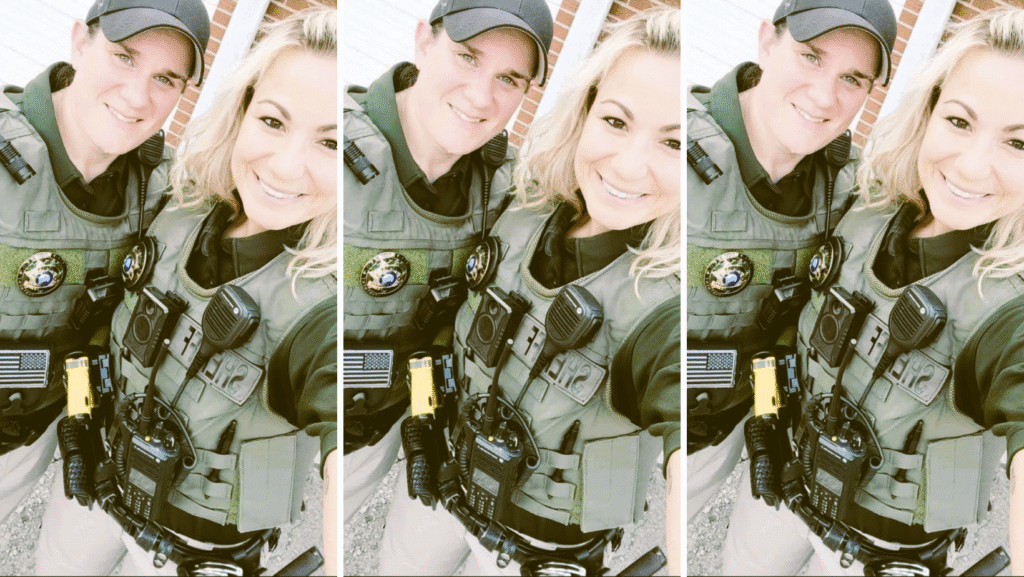
Today is National Police Woman Day, a time set aside to honor the women who wear the badge. In Moore County, that recognition belongs to Deputies Maygan Silavong and Erin Haggard, two trailblazers who have answered the call to serve and, in doing so, are reshaping what law enforcement looks like in a small Southern town.
When Mama Called
Legendary University of Alabama Head Coach Paul “Bear” Bryant once famously said, “When Mama calls, you just have to come running,” when explaining to a sportswriter why he decided to leave a successful Texas A&M program to return to his alma mater in 1958.
For local officers Maygan Silavong and Erin Haggard, their positions at the Metro Moore County Sheriff’s Department (MMCSD) followed a similar path.
A native of California, Maygan moved to Lynchburg at just six-years-old to live with her grandparents, Sharon and Richard Howse, along with her sister, Rheannon Gagnon, who works in Lynchburg as a paramedic. She attended Lynchburg Elementary School, until the age of 12, when she decided to move back to California to be with her parents.
“Grams and Pop were strict,” she says. “I was at a rebellious age and knew I could get away with more in California with my parents.”
At the age of 24, she decided to become a corrections officer and attended The Academy at the California Department of Corrections in Victorville. Two years later while working corrections in Las Vegas, she got a call from Rheannon that changed everything.
“One day my sister called and told me she was engaged. I was pregnant with my first child. Something about it just hit me suddenly and I realized I didn’t want to raise my kids in Las Vegas. I also really missed my sister.”
After several years as a Moore County corrections officer, Chief Deputy Shane Taylor approached Maygan about attending The Tennessee Law Enforcement Academy and becoming one of the first female deputies here in Moore County. In addition to her role as an on-the-road deputy, Maygan also serves as the department’s Public Information Officer and Social Media Coordinator.
Erin’s journey into a Moore County patrol car looks similar.
A native of Dixon County, Erin graduated from Dixon County High School where she excelled as a girls’ softball pitcher. Her arm earned a scholarship to play at Birmingham Southern College, a Division I school. After graduating with an education degree, Erin decided teaching wasn’t her path.
Around the age of 25, her paternal grandmother, who lived in Coffee County, became sick. One of her dying wishes revolved around knowing that her grandkids would be okay. That’s when Erin lasered in on law enforcement.
“I told her not to worry that I was going to become a police officer,” Erin explains. “I think that might scare most grandparents but the fact that I had a path seemed to put her at ease.”
Her grandmother passed in 2009, and Erin moved back to Coffee County and began working at the Coffee County Sheriff’s Department where she served for a little over four years before taking a position at the Knoxville Police Department.
“After seven years, I got a little homesick,” Erin says. “After my maternal grandfather also passed, I decided to come home.”
She took the position of deputy at the MMCSD in 2021 and now serves as a sergeant.
“They don’t baby us.”
In small towns like Lynchburg, female officers often struggle with operating inside the good old boy network. Both Maygan and Erin say in the beginning they felt the need – whether from internal or external pressure – to prove themselves just a little more.
“I felt like I had to prove myself in the male world in addition to the pressure that came from being a rookie,” Maygan says. “You’re really trying to find yourself in a world that no one thinks you belong in.”
Erin says her experience in the early days felt similar – something she initially thought was unfair.
“It is absolutely a male-dominated field. When I first started, I’d walk into a room full of guys, and it would go silent. It felt like they didn’t trust me or were afraid to offend me,” Erin says. “Then I heard my dad’s voice inside my head saying, ‘So what? Get over it. Suck it up. If it’s worth it to you, do the extra work.’”
In the end, both women agree that proving yourself is part of the story arc of every green deputy that walks through the Moore County Sheriff’s Department front door.
“What’s great about working in Lynchburg is that everyone in this department wants to prove themselves every day,” says Maygan. “The men we work with are awesome. They don’t baby us. They’re constantly pushing us past our comfort zone. They also respect us and treat us as equals.”
A Combined Force
Both Maygan and Erin work with male partners. Maygan and Lieutenant Dustin White work together. Erin and Deputy Cody Lanier are a team. Both agree that the jobs of law enforcement requires both the male and female points of view – especially in a small town where law enforcement is about living among the people you serve, knowing them personally, and balancing community trust with authority.
Where male officers traditionally look to immediately command presence and project strength, female officers often lean back and use their intuition to read the situation before engaging. One’s not better than the other – they are complimentary approaches.
“You become really good at reading people,” Erin says. “My partner is male, and within the first couple minutes on an incident, I can pretty much figure out whether the person will be receptive to talking to me or not. And some of them, it’s actually shocking, some of them are a lot more receptive to me.”
Maygan says male egos can flair under pressure – especially during domestic violence cases where emotions are already running hot.
“Once, I needed to work a domestic case by myself, because my partner was too far away,” she says. “I had everyone calm and separated, but as soon as my partner walked in the door, the husband immediately fired back up.”
Erin says she’s experienced something similar but opposite.
“You’d be surprised how many times we show up as second on a scene where someone is cussing and arguing, and they immediately soften. It’s the weirdest thing.”
Both women also explain that their perspective can be helpful in domestic cases.
“If you have a female victim, she’ll often open up more to one of us,” Erin says.
Maygan is quick to remind that men can be domestic violence victims too.
“In some domestic violence cases, it’s not always the women who are victims,” Maygan says. “A female aggressor will try and manipulate a male officer and play the victim. We sometimes read body language better and catch social cues that the guys miss.”
Both agree that individuals can have strong knee-jerk reactions to either a male or female officer for hundreds of reasons, and that boasting both on the Moore County department serves as a useful tool for both de-escalations and effective communication both inside and outside the department.
“Men tend to bottle up their emotions,” Maygan says. “They won’t talk. Communication can get a little low. I feel like since Erin and I have gotten here that’s changed.”
Maygan says since she and Erin arrived, the department as a whole has also gotten better about doing the “girlier” things like participating in community events like Halloween in the Hollow or hosting inter-departmental holiday parties.
“Overall, I just feel like having both men and women makes us a stronger department,” she says.
In the end, both women say internally they’re treated just like “one of the boys” and externally they experience respect in 99 percent of situations.
In places like Lynchburg, where most calls don’t involve hardened criminals but rather mental health issues, addiction, or generational trauma, it’s important to use all available tools including communication to try and diffuse things.
“I’ve talked myself out of so many situations. Just talking calms down the situation,” Erin says.
Opening the Door for the Next Generation
Both women get a kick out of the wide-eyed smiles they often receive from local elementary school girls, when they realize that being a deputy is something “a girl can do too.”
“The little girls love us,” Maygan says.
It makes both women feel good about opening the door just a little bit wider for the next generation of female deputies. When we ask what advice they might give any girl, teen, or woman thinking about going in law enforcement, they are both quick to answer.
“Don’t think twice and go for it,” Erin says. “It’s a possibility and you can do it. Don’t let anyone tell you any different. You don’t have to be big and strong. You can attend the academy even if you’re never shot a gun. They’ll teach you.”
“Yeah, they’ll each you all the things,” Maygan reiterates. ‘When most people think about being a cop, they think about the physical, but knowing how to communicate is just as important.”
Local officers Maygan Silavong and Erin Haggard stand as proof that when the call comes, women can answer it just as fiercely as men. For Moore County, that means a stronger, more balanced department – and for the next generation of little girls peeking up at the badge, it means the door is already open.•
About The Lynchburg Times
The Lynchburg Times is an independent, woman-owned newspaper rooted in the heart of southern middle Tennessee. Led by a Tulane-educated journalist with over two decades of experience covering this region, we shine a light on the people, politics, and cultural pulse of a changing South. From breaking news to slow storytelling, we believe local journalism should inform, empower, and preserve what makes this place unique. Supported by readers and community partners, we’re proud to be part of the new Southern narrative – one story at a time. [Support us here.]