

By Tabitha Evans Moore
Editor & Publisher
It’s Saturday afternoon and local Buford Jennings and I sit in the living room of his unassuming home located off Marble Hill Road near the Moore County, Franklin County line. A giant Christmas cactus sits between us and I can’t help but wonder how he grew it that big — its the circumference of a whiskey barrel. Buford attributes its thriving to Frances Hart, his constant companion for the past 24 years. They were college sweetheart who connected later in life after his wife died.
Like a lot of things in Buford’s life, there’s probably luck involved.
Jennings grew up in Lincoln County. His ancestors have lived in Southern Middle Tennessee since the 1800s. He attended a one-room school in Champ with just 17 students before it closed and he transferred to Kelso. He and sons, Walt and Todd, own a 150 acre Century Farm off County Line Road that they recently protected with a conservation easement through The Land Trust for Tennessee.
Local with deep roots, farmer who values land, even accidental master gardener — one might intuit these things about Buford with a single glance. What you might not image is that he is one of three men to hold the patent on an invention that his still shaping America’s military defense to this very day.
The single most important advance in precision weaponry since World War II
In 1960, a scientist named Theodore Maiman built the first working laser at Hughes Aircraft. The technology was a sensation. Nobody could agree on what it was for.
“Everybody knew lasers would be good for something,” Jennings says. “But nobody knew what.”
He was a young physicist at Redstone Arsenal in Huntsville, working for a group that had decided to get into the laser business and figure it out. They’d sit around a table and throw ideas back and forth. Somewhere in that process, a question surfaced: Why can’t we figure out how to guide a missile with a laser?
That question, worked through and refined and argued over, became several patents but the it’s U.S. Patent 4143835 granted in 1979 that changed everything. It’s for “a system for intercepting a target with a missile having semi-active homing guidance. The target is discretely illuminated by a laser beam and the missile homes on the reflected illumination from the target,” according to the U.S. Patent office.
Buford Jennings, William McKnight, and Richard Milton filed for that first patent in 1964. Due to litigation with a defense contractor — a competing claim that went on for 15 years — it wasn’t officially awarded until 1979.
By then, it was already in use.
“The patent belongs to the U.S. Army,” he says simply, when I ask about royalties. “I got three or four hundred dollars when we filed. Another three or four hundred when it was awarded. That’s it.”
Six hundred dollars. For technology that now guides the Hellfire missile — the primary armament of the Apache helicopter — and has been deployed in every major U.S. military engagement since Desert Storm.
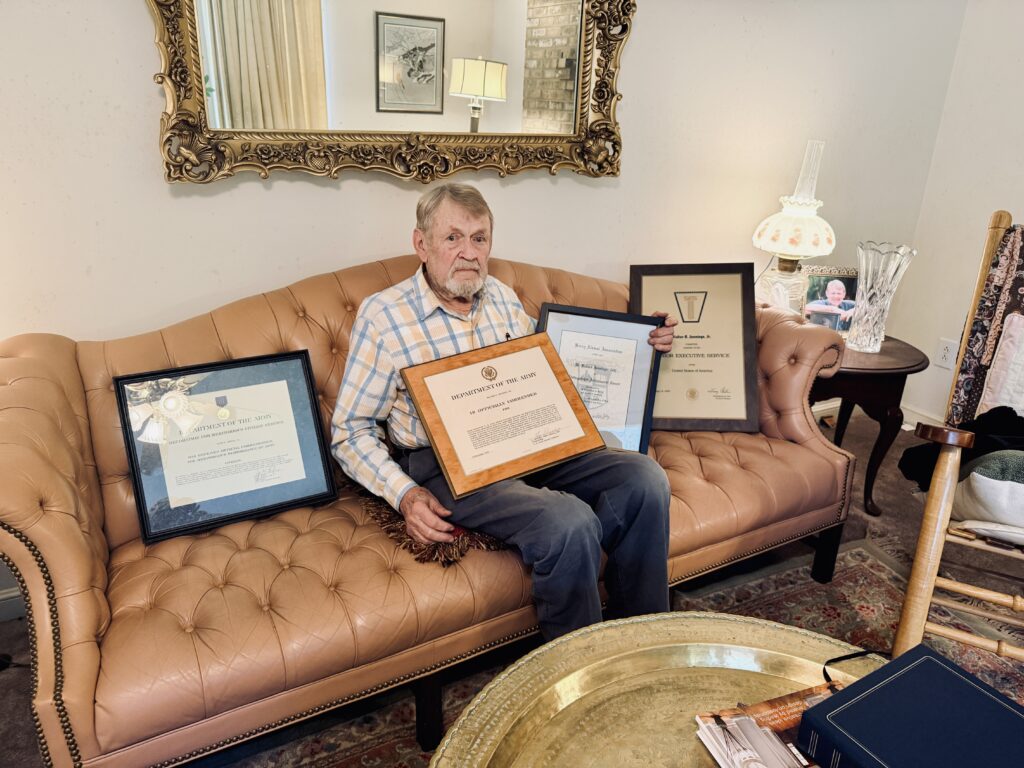
A commendation from 1972, which he pulls from a stack of framed documents he hasn’t gotten around to hanging, reads: “This concept resulting in the introduction of laser guided weapons is perhaps the single most important advance in precision weaponry since World War II.”
He holds it toward me so I can read it.
“That statement,” he says, “is the essence of it.”
Lasers are everywhere
The road from Champ to Redstone Arsenal was not a straight one, and Buford will be the first to tell you luck had something to do with it.
He attended Berry College in Georgia — largest campus in the world, he notes, 27,000 acres — and spent summers interning at Redstone starting in 1956. After graduating, he accepted a teaching job at a private high school in Georgia when his old physics professor called with another idea — an assistantship at Emory University.
“I said, ‘I would be, except I’m supposed to start a new job Monday morning.'”
“You don’t have a job,” his professor told him. “I already got somebody to take it.”
He went to Emory, then came back to Redstone in 1961.
His career followed lasers the way rivers follow valleys. After the guidance work, he moved into high-energy laser weapons research — the longer game, the harder goal. In 1976, his team built a laser inside a Marine Corps amphibious assault vehicle and shot down drones at 500 meters. The technology was on the right track. The world just wasn’t quite ready.
Along the way, the lasers went everywhere. He opened his lab to medical researchers from Walter Reed, the National Institutes of Health, the University of Louisville. In 1965, a doctor from the NIH Cancer Institute used a laser Jennings’ team had built to remove the bottom lobe of a rhesus monkey’s liver. It didn’t bleed. The laser cauterized as it cut. The paper was published in the Journal of the American Surgeon, gold medal.
“That technology has gone in every direction,” he says. “Every time you check out at Woodard’s, that’s a laser. Your detached retina — that’s a laser. It’s invaded every aspect of our life.”
He rose through the civilian ranks to GS-16, the top of the scale. When Jimmy Carter established the Senior Executive Service in 1979 — the civilian equivalent of flag officer rank — Jennings was a charter member. His certificate was presented at the Pentagon. The protocol, he mentions with what might be the faintest trace of amusement, was equivalent to a one-star general.
“I worked for four different colonels as their deputy,” he says. “And I actually carried a higher protocol than they did. We’d go to White Sands Missile Range and stay in the BOQ. My room would have an open free bar.” He pauses. “My bosses didn’t.”
A tool in the defense of freedom
The night the U.S. entered Desert Storm, Buford Jennings stayed up until dawn watching CNN.
Apache helicopters armed with Hellfire missiles were among the first assets into Iraq. The illuminators on those missiles use a neodymium YAG laser — the same wavelength, one point zero six microns, that his team had been working toward since 1964. He watched it work in real time on live television.
“I called Bill McKnight,” he says. McKnight, his co-inventor and former boss, was already retired and living in Tuscaloosa. “I said, ‘Bill, have you seen this?'”
McKnight called back a few days later. He had been planning to go fishing the morning the war started.
“He said he never made it to the lake.”
Both McKnight and Milton have since died. Most of the people Buford worked with at Redstone are gone. He still goes down occasionally for a monthly lunch with old colleagues, though the group grows smaller.
I ask him whether there’s anything about the technology that keeps him up at night.
“No,” he says. “When I retired, I erased that memory. That’s when I started raising cattle.”
He says it without drama. Next chapter. Time to move on.
When I press him on the moral weight of it — on what it means to invent something that kills — he’s measured. He notes that precision guidance means fewer misses, less collateral damage, fewer civilians in the crossfire. He first worked on the project post World War II, right after the United States led the world in the fight against fascism. The words from a framed U.S. Army Commendation says it best: a tool to be used in the defense of freedom.
He adds, quietly, that he’s a little confused about what that means these days and some of what’s happening at the Pentagon right now. He calls it amateur hour, and hopes it’s temporary.
“Who knows,” he says.

“I’ve just been lucky.”
He has been on the Duck River Electric Membership Corporation board for 27 years and just won his tenth consecutive three-year term. The Tennessee Farm Bureau gave him its Distinguished Service Award at the state convention in December 2025. His Century Farm is in a conservation easement. His and Frances’s Christmas cactus is enormous.
The framed plaques and certificates are still in a stack. He keeps meaning to hang them.
I ask what a younger version of him — the boy hauling corn on the hill above Champ — would think about all of this.
“Oh,” he says. “He’d be surprised.”
And does the trajectory of his life feel like fate or like something he built himself?
“I’ve been in the right place at the right time many times,” he says. “I’ve just been lucky. Very lucky.”
He says it the way men of his generation say things they mean completely: simply, without performance, and without any apparent need for you to agree. •
About the Lynchburg Times: The Lynchburg Times is Moore County’s locally owned, independent news source. Our reporting is supported by readers, small business partners, and underwriters who believe community journalism matters. If this story was valuable to you, consider becoming a supporter at lynchburgtimes.com.