
By Tabitha Evans Moore
Editor & Publisher
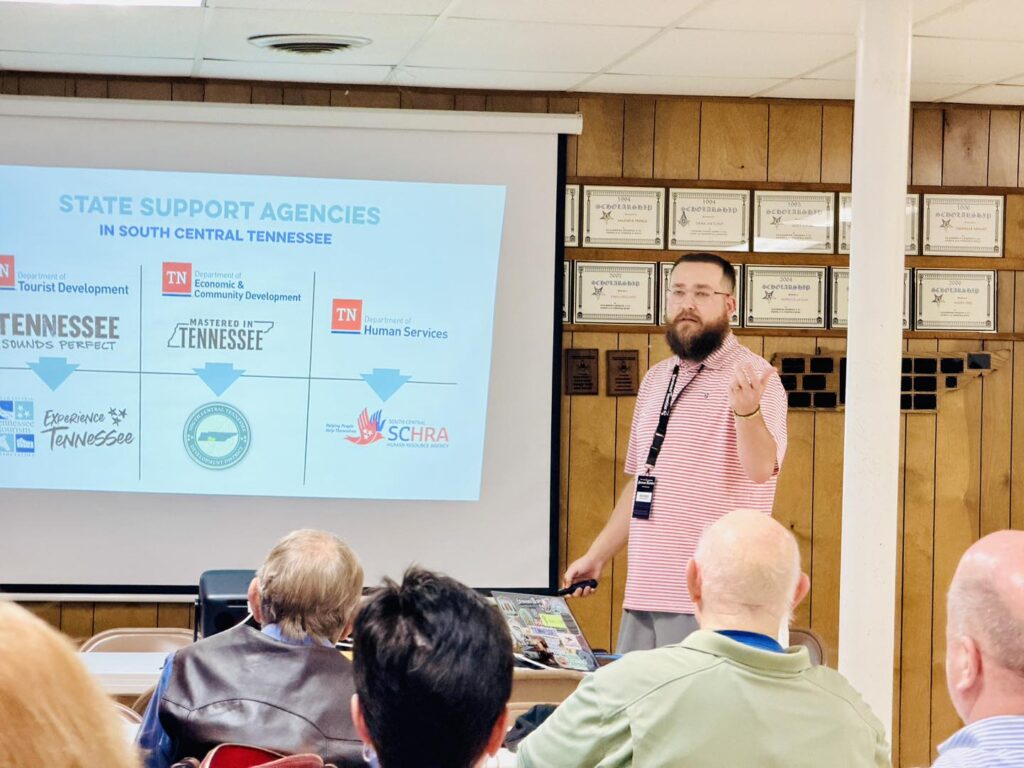
It’s Sunday afternoon and the Masonic Lodge is filled with around 20 folks from Lynchburg and the surrounding area to listen to local tourism guru Ryan French speak at the March Moore County Historical Society meeting. He’s dressed in his “uniform” — khaki shorts, golf shirt, and Experience Tennessee lanyard. Even on a casual Sunday, when he places it around his neck, he transforms from husband, dad, music lover, history buff, and an avid turtle saver into a dogged evangelists for Lynchburg and the surrounding counties as the CEO of the South Central Tennessee Tourism Association (SCTTA).
Ryan hails from Lynchburg and graduated in from Moore County High School in 2004. He grew up in Lois Community as a child. He currently lives in Manchester with his wife and five boys and serves on the Manchester City Council — a seat he’s held for the past 17 years. He won his first election at the age of 23 and says the first couple of years were a bit of a bumpy road.
“I had all these grand ideas like making the Coffee County Fair free. Politics were a lot different back then,” he says.
Freshman city council members — especially those in their early twenties — don’t always receive the choice committee selections, and the mayor assigned Ryan to the landfill and adult entertainment committees. Manchester doesn’t boast much of either.
“I guess they thought at my age, I would fit in those committees. To this day, I don’t think either have ever met,” he jokes.
Eventually, he implored the mayor to appoint him to a group that met occasionally. She acquiesced and assigned him to the tourism committee, where he became the only man and certainly the only twenty-something among a group he now lovingly calls the Tourism Grannies.
“We had different ideas and at first, they hated me and I pretty much didn’t like them. Today, they’re among my closest friends. I love them all,” he says.
His tourism matriarchs taught him how to slow down, look around, and appreciate all the unique events, places, and characters that make the 13 counties he now oversees — destinations with some of the most culturally and historically rich tourist attractions in The South.
That appreciation led him into a tourism career at the SCTTA in 2020. In six short years, he’s accomplished much including the Destination Marketing Organization (DMO) Director of the Year in 2024 and networking to get our small Tennessee towns earned media in publications like National Geographic, Southern Living, and Travel + Leisure.
From South Central Tennessee Tourism to Experience Tennessee
When Ryan took the helm of the South Central Tennessee Tourism Association in 2020, one of the first things he did was rename what people see. The organization’s legal name stays the same, but the brand he pitched to the world was Experience Tennessee.
“South Central Tennessee Tourism Association, I don’t think that’s very marketable or pronounceable,” he says with a laugh.
The rebrand was rooted in something deeper than catchiness. The 13 counties he oversees — stretching from Coffee and Franklin County east to the Cumberland Plateau and west to Perry and Wayne County on the Tennessee River — offer something rare: an entire miniature version of the state packed into one region. You’ve got mountain terrain near Sewanee, flatlands to the west, rivers, woodlands, foothills, and everything in between.
“It’s very experiential based,” he says. “We wanted to really talk about the experience.”
One of his first moves after settling into the job was to relocate the SCTTA offices to Lynchburg.
“This is where the destination is. This is where the visitation’s coming from,” he says.
By 2022 the office was operating out of the County Building, and Ryan began his next play: approaching Jack Daniel’s about the old welcome center that was sitting largely unused after COVID, filled with motorcycles and benches. He pitched turning it into a regional welcome center, and then quickly followed up with the Tennessee Whiskey Trail organization about co-branding it as the official Tennessee Whiskey Trailhead. The trail runs 40 distilleries from Memphis to Gatlinburg, and most visitors hear about it for the first time right here in Lynchburg.
“It made sense to make Lynchburg the place to start your whiskey trail,” he says.
Navigating the Alphabet Soup of Tennessee Tourism
Ryan takes a few minutes of his presentation to walk the room through exactly how his organization fits into the larger tourism landscape, because, as he puts it, “It’s convoluted. It’s not easy to explain.” The short version: in 1973 the Tennessee legislature created a network of regional support agencies — one each for tourism, economic development, and workforce development. SCTTA is the tourism support agency for Southern Middle Tennessee. They’re not the state of Tennessee, but they work closely with the Tennessee Department of Tourism, the Tennessee Hospitality and Tourism Association, and a constellation of local Destination Marketing Organizations, or DMOs. Ryan currently works directly with 21 DMOs across his 13 counties, as well as 13 county governments and 37 municipalities. Part of the job is fun travel and boots-on-the-ground work. Part of it is wading through a lot of government.
“That’s what I get to do and it’s neat telling people how it all works,” he says.
Ryan says he’s proud of what the region has become under his watch and the watch of his team. SCTTA had never won a Purple Iris Award — the state’s top tourism honor — in its roughly 50-year history. In the last two years alone, they’ve won three. Beyond his own DMO Director of the Year recognition in 2024, Media Director Sofia Posey won Tourism Employee of the Year and Operations Director Amanda McGowan was named to the Tennessee River Valley Stewardship Council just this past year.
What the Numbers Tell Him
Ryan is a data guy. He talks about visitor spending statistics and state economic impact reports the way a coach breaks down game film: with focus, context, and a clear eye on what the numbers mean for what happens next. Tennessee tourism is a $31.7 billion industry — the second largest in the state, behind only agriculture. In 2024, the state welcomed 147 million visitors who generated $3.3 billion in state and local taxes. Tennessee has climbed to 11th in the nation in visitor spending, a remarkable position for a state with no coastline and no casinos.
“We’re number one among states without a coastline or a casino,” he says.
One of his favorite data points involves Moore County’s own story. When he took the job, Moore County was ranked dead last — 95th out of 95 counties — in Tennessee’s annual tourism economic impact report. Only 10 jobs in the entire county were attributed to tourism. Ryan knew that was wrong.
What he eventually uncovered was that Jack Daniel’s, which had grown its visitor experience organically over decades, had long been reporting much of its tourism-related activity under agriculture and local visitors weren’t being captured economically under tourism. He worked with the distillery and the state to correct 10 years of data. The results were immediate: Moore County is now ranked 63rd and was among the top 10 fastest-growing counties in the entire state in 2024, posting 10.6 percent growth year over year.
“And that wasn’t for the correction,” he clarifies. “That was year over year. We were still in the top ten.”
South Central Tennessee as a whole now claims four of the 10 fastest-growing tourism counties in the state, and all four are rural.
The data also revealed something striking about the nature of Moore County’s economy. Using a location intelligence company called Zartico, Ryan’s team was able to break down who is actually making purchases in the county. The findings: 48 percent of every transaction in Moore County is made by someone who lives more than 50 miles away, and another 33 percent comes from within 50 miles but outside the county border. Only 19 percent of every transaction that happens here is made by someone who actually lives in Moore County. Compare that to Bedford County, where roughly 68 percent of transactions are local.
“Eighty-one percent of the spending that happens in Moore County is made by visitors,” he says, letting that sink in. “Every single transaction.”
Lynchburg’s Missing Piece: A Place to Stay
The numbers are good, but Ryan sees a significant gap. A visitor survey of roughly 5,000 Lynchburg visitors — drawn in partly by the promise of Dollywood season passes in a drawing — revealed something that keeps him up at night. Seventy percent of people who visited Lynchburg had originally planned to spend four to six hours or more in town. But when asked how long they actually stayed, the number flipped: 70 percent spent four hours or less.
“We’re forfeiting that time,” he says. “And where does most of it go? Back to Nashville. Back to Huntsville. The last thing Nashville needs is four more hours of our visitors.”
The economics make the case plainly. A day visitor in Tennessee spends an average of $115. An overnight visitor spends $329, and that’s over two days, making the tax impact four times greater than a day trip. Right now, only three percent of visitor spending in Moore County goes to lodging — a half-million dollars in a $15.5 million visitor economy. Ryan’s goal is to change that.
He’s responding with new tools to extend the visit: the “After Jack” program, which hands departing visitors a booklet of six scenic routes back toward Nashville with stops in Shelbyville, Tullahoma, and Fayetteville along the way; a printed visitor map of the Lynchburg square that has already seen more than 250,000 copies distributed; and large outdoor wayfinding maps now installed at the gazebo, the Trailhead, and the public restrooms building. To that end, SCTTA has also received a grant to fund a formal lodging study for Moore County. A survey will be circulated shortly, and Ryan made a point to ask the Historical Society crowd to help spread the word.
“We’re not skewing it,” he says. “We just want real information.”
The Sales Tax Argument He Didn’t Quite Make
Despite being an elected official in a neighboring county, Ryan is careful to avoid local politics in his tourism work. He says so directly and more than once during the presentation. But the numbers make an argument even when he’s not making it himself.
Tennessee has no state income tax, which means the state runs heavily on sales tax revenue. The current rate here in Lynchburg sits at 9.25 percent — half a cent less than the surrounding counties. Ryan points out that a visitor spending $1,000 in Tennessee generates $95 for state and local government, compared to $70 in Florida, $74 in North Carolina, and $58 in Virginia. Tennessee benefits disproportionately from visitor spending because of its tax structure, and that means communities that attract overnight visitors have a powerful revenue engine that doesn’t require residents to open their wallets. His Zartico data drives this home: if Moore County were to raise its local sales tax, 81 percent of that burden would be borne by visitors, not locals.
“I’m not getting into your politics,” he says. “Those are just facts.”
He also notes that every community surrounding Lynchburg already operates at a higher tax rate. He leaves the rest of that sentence unspoken, but the room gets it.
What’s Coming in 2026
Ryan wraps up the presentation with the things he’s most excited about heading into 2026, and the list is long. The Tennessee Whiskey Trail mural program is rolling out interactive check-in signage at murals in Lynchburg, Fayetteville, and Tullahoma. Visitors who check in at all three will earn a bonus poker chip at the Trailhead — adding an incentive to venture beyond the distillery and spend time and money in downtown Fayetteville and Tullahoma in the process. The campground at the park is getting a full digital overhaul: online reservations, QR code check-in, and an automated follow-up that pushes the Lynchburg visitor map and dining recommendations directly to campers’ phones.
“If they’re staying in that park, they’re going to walk up on the square and spend a lot of money,” he says. “That’s the whole idea.”
There’s also a new Icons and History Marker Program that will roll out 13 new markers across the region’s 13 counties in 2026, following the model of the Bill Dance marker recently placed in Lynchburg in partnership with the chamber and the distillery. The markers highlight iconic figures and places in Tennessee history and will be tied to a new Experience Tennessee guide called History of the Volunteer State. Ryan makes a direct pitch to the Historical Society crowd with this one: heritage travelers spend more money, stay longer, and are more deliberate in the way they engage with a community.
“A lot of people are here for the history, and that’s opportunity for us,” he says. “Lord knows we’ve got stories to tell here.”
Perhaps the most anticipated project of the year is a guided history tour of Lynchburg, to be developed in partnership with the Welcome Center and rolled out before the end of summer. Think golf carts — street-legal ones, with blinkers — rolling through town past the square, down side streets, and into the history of a community that most visitors only scratch the surface of. A self-guided version using a printed tour brochure is also in the works. The goal, as always, is the same one that’s driven every project Ryan has launched since arriving: get people to stay a little longer.
“If we get them to four and a half hours, I’m happy,” he says. “Anything and everything to extend it.”
As the Q&A winds down and folks begin pulling on coats and gathering their things, Ryan is still answering questions — about the Whiskey Trail, about horse archery tournaments in Marshall County, about what the America 250 celebration might mean for international visitation. He’s still wearing the lanyard. You get the sense he wouldn’t know how to take it off.
If you’d like to learn more about Ryan’s work and the 13-county area he promotes visit the Experience Tennessee website. It’s full of things to do, places to eat, and ways to learn more about the small towns we all love and call home. •
About the Lynchburg Times: The Lynchburg Times is Moore County’s locally owned, independent news source. Our reporting is supported by readers, small business partners, and corporate underwriters like our friends at Lee Adcock Construction who believe community journalism matters. If this story was valuable to you, consider becoming a supporter at lynchburgtimes.com.