

By Tabitha Evans Moore
Editor & Publisher
Kaleb Wilson didn’t plan on becoming the kind of guy people ask to speak at a 9/11 memorial race. But this Saturday, he’ll appear before the crowd at Lynchburg’s Tunnel to Towers 5K and Walk and tell them about a bet, a pond, and everything that came after.
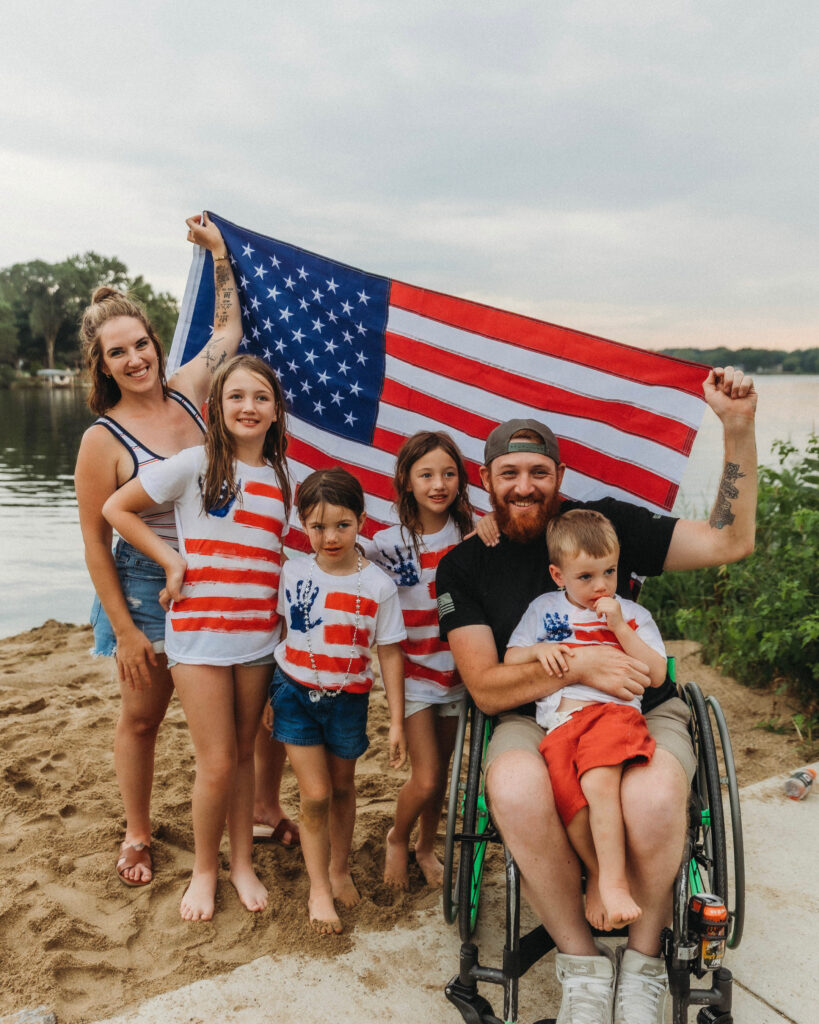
Kaleb, a C6-C7 quadriplegic, broke his neck in 2012 while stationed with the U.S. Coast Guard near on Lake Pontchartrain in New Orleans. He was off duty at the time — a friend dared him to dive into a pond and swim across. He took the bet, dove in, and hit the bottom resulting in a spinal cord injury that left him paralyzed in his lower extremities. The injury ended Wilson’s plans for a career as a Coast Guard rescue swimmer, his dream job.
“That’s all I wanted to do in the Coast Guard. That’s all I had focused on. There was nothing else in the Coast Guard I wanted to do,” Kaleb says.
But more than a decade later, he and his family are on the verge of a new chapter: a mortgage-free, fully accessible “smart home” through the Tunnel to Towers Foundation, to be built in Murfreesboro.
The Wilsons exist as a shining example of how the foundation turns tragedy into triumph and why events like the Lynchburg race feel like an important way to heal the devastation of September 11, 2001.
Their path to Saturday started with an ordinary conversation at the gym. Wilson’s wife, Brittany, struck up a conversation with a woman wearing a Lynchburg Tunnel to Towers t-shirt. That person happened to be Jack Daniel Distillery’s Single Barrel Manager Janelle James.
“I saw the shirt and thanked her for supporting the organization that has and will continue to do so much for our family,” Brittany says.
When local event organizers were looking for a keynote speaker for this year’s Lynchburg event, Janelle remembered the conversation and recommended Kaleb.
He will speak on Saturday, September 12 just prior to the event’s 7:30 a.m. start.
NORMAL LIFE AND PEACE OF MIND
Kaleb and Brittany decided to research the Smart Home Program after a friend— who had recently gone through the process — encouraged them apply. They were already searching for grants or assistance to install an elevator in their current two-story Murfreesboro home. They applied, got accepted into the program, and are now in the land acquisition phase.
Kaleb and Brittany have four children — Eloise, 9; Nola, 8; Palmer, 6; and Rowan, 3. Their current home has a master bedroom and second bedroom on the first floor, with three more bedrooms upstairs. Without an elevator, Kaleb says Brittany takes on most of the upstairs responsibilities — getting the kids up in the morning, cleaning, bedtime routines — while he makes do crawling up and down the stairs when he needs to.
“It’s doable but not ideal,” he says.
The bigger concern is safety. Brittany works as a social media and brand consultant who often needs to travel for work. If one of the kids gets hurt upstairs while he’s home alone with them, he can’t easily reach them — and he can’t carry an injured child down the stairs. Their new home will relieve that tension.
The Tunnel to Towers’ Smart Home Program builds fully accessible homes tailored to each recipient’s needs. For the Wilsons, that will mean a single-story design with automated blinds and lights controlled through a tablet, doors that open automatically, and barrier-free entry points at the front door, back door and garage — no ramps required.
“If there’s an emergency, I’ll easily be able to get there and help,” Kaleb said of what the new home will mean. “But also, it’s the little things — I can tuck my kids in at night, I can read at night to them. I can do those things without crawling up the stairs, getting my chair upstairs, getting in the chair, coming back down the stairs with my chair.”
Beyond the physical home, Kaleb said the mortgage-free nature of the program lifts a significant financial burden. Because his injury is considered a pre-existing condition, Kaleb says, life insurance has been difficult to obtain, and his family’s income depends heavily on his VA benefits.
“It gives me the peace of mind for my family,” Kaleb said. “If something was to happen to me that stops. At least this way my wife and kids will be able to be taken care of with a roof — and that’s not something they’ll ever have to worry about.”
Kaleb also pointed to a newer piece of the foundation’s work: the Mae and George Siller Tunnel to Towers Foundation Scholarship Program. Recently absorbed into the foundation, it now provides full tuition for undergraduate programs and trade schools to the children of families in the Smart Home Program, the Fallen First Responder Program, and Gold Star families.
“That’s a huge burden off of our shoulders as well,” he said.
THE DREAM OF LOS ANGELES IN 2028
On Saturday, Kaleb plans to talk about his journey from the Coast Guard through his injury to where his family stands today, along with the history of Tunnel to Towers itself — founded in honor of Stephen Siller, a New York City firefighter who died on September 11, 2001, and now marking its 25th anniversary.
Wilson was 10 years old and living in a small town in Wyoming when the attacks happened. He remembers his parents talking with him about what was unfolding, and says they managed to make him feel safe even as the news broke.
“I don’t remember being scared, really, at the time,” he said. “My parents did a great job of protecting me.”
Looking back, Kaleb sees the foundation’s growth as a kind of transformation — grief turned into something sustaining for others. What began as support for first responders has expanded to cover those with catastrophic injuries sustained in the line of duty, combat injuries, and service-connected disabilities more broadly.
“To be able to grow to the point where you’re not just focused on one group, but you can branch out to more that have been affected,” Kaleb said.
Kaleb comes alive when he talks about a new athletic pursuit — one that helps him remember why he joined the Coast Guard in the first place — competitive swimming. A former high school swimmer, he’s spent the past year training with hopes of competing in the Paralympics in Los Angeles in 2028.
“That’s something I never would have had an opportunity to do if it wasn’t for the injury,” he said.
The Tunnel to Towers 5K and Walk begins at 7:30 a.m. Saturday in Lynchburg. It will join 93 other events happening across the U.S. from Baton Rouge to Delaware and Sacramento to Atlanta. The Lynchburg event hopes to raise $10,000 to help others like The Wilsons. If you’d like to donate, you can do so by following this link.
As for Saturday, Kaleb says his biggest job is just showing up and living as a shining example of how much good the program everyone is there to support has done for him personally. •
About the Lynchburg Times: The Lynchburg Times is Moore County’s locally owned, independent news source. Our reporting is supported by readers, small business partners, and underwriters who believe community journalism matters. Our small business profiles are sponsored by First Community Bank. If this story was valuable to you, consider becoming a supporter at lynchburgtimes.com.