

By Tabitha Evans Moore
Editor & Publisher
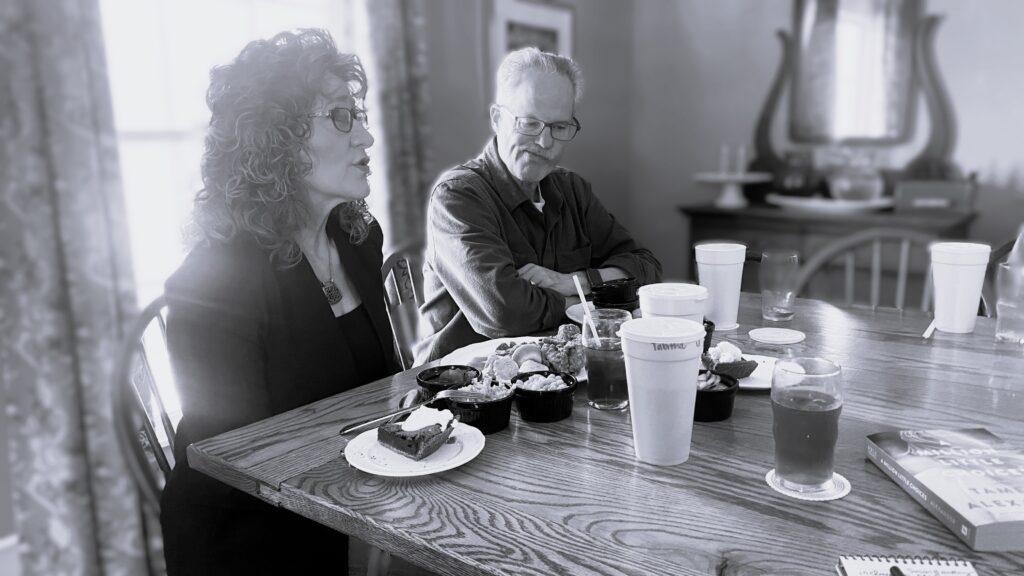
Recently, I was among a small group invited to sit down with Nashville-based author Tamera Alexander at Miss Mary Bobo’s Restaurant — a gathering that included Mike Northcutt of the Moore County Historical Society, restaurant manager Michelle Potts, several of Miss Mary’s hostesses along with Moore County News reporter Roberta Adams. The occasion was an early look at Alexander’s upcoming novel, In These Hills, set right here in Lynchburg in 1905. To our knowledge, it will be the first novel ever set in this town.
That alone would be worth reporting. But the fuller story is considerably richer.
{Editor’s Note: We work hard to keep you informed. Make sure you never miss a story. Get every new headline delivered straight to your inbox with Lynchburg Times News Alert. Sign up here.}
The writer and the place
Tamera Alexander is not a tourist who fell in love with Lynchburg on a distillery visit. Her people are from here.
Her father’s family is from Gattis Town — a community that no longer exists except for a cemetery and a scattering of rocks near Lois — and she grew up making the trip from Atlanta to her great-grandmother’s house on Norris Street in Fayetteville every summer, always passing through Lynchburg on the way. Her great-grandmother, Agnes Preston Tripp Gattis, spoke about Jack Daniel personally. Family members worked at the distillery at the turn of the century.
“I remember my great-grandmother talking about Jack Daniel,” she told the group. “I remember them talking about my ancestors having worked for Jack Daniel, for the distillery at the turn of the century. My great-great grandfather broke mules for the operation.”
Tamera’s written historical fiction since 2006. In These Hills will be her twentieth novel. Several have appeared on the USA Today bestseller list, and her work has been published in seven languages. Her publisher for this book is Tyndale Publishers — one of the largest Christian publishing houses in the country.
Her husband Joe, she said with a laugh, had been after her for years to write this book.
“He has been after me for years to write a story about Jack Daniel. And, to my knowledge, no one’s ever done a novel about this,” she told the group.
She credits the years she spent writing other historical novels — including her well-known Southern Mansions series set at Belmont, Belle Meade, and Carnton — with giving her the craft and confidence to tackle a subject this close to home.
“This one was intimidating,” she said plainly. “Jack Daniel’s is not only a national brand — it’s a treasured history. Miss Mary’s has a treasured history. I wanted to write it in a way that was authentic to the times and that honors the real people who are characters in the novel.”
The story
In These Hills opens in Atlanta in 1905. Josephine Dunham — a young suffragist, 24 years old — is forced to flee the city after a violent encounter following a suffrage rally. She makes her way to Tullahoma and then to Lynchburg, believing it to be a quiet place to disappear. She is wrong about that.
The Lynchburg she arrives in is buzzing. Jack Daniel has just won the gold medal at the 1904 World’s Fair in St. Louis. His business is growing. Notoriety is building. Josephine, who can’t cook and has few marketable skills in 1905 Tennessee, ends up working in Jack Daniel’s office — a suffragist and prohibition sympathizer now employed by the most famous whiskey man in the state.
“The conversations between Josephine, a suffragist, and Jack Daniel,” Alexander said, smiling at the irony she’d engineered. “It almost felt like — this has happened before with other characters — the characters just tell you what they’re going to say and do.”
Susan B. Anthony appears in the novel, elderly and still active in the suffrage movement in the months before her death in 1906. Miss Mary Bobo is rendered in full — sharp, exacting, generous in her own way, operating a boarding house with the authority of a woman running a small empire.
“From what I’ve learned, she was very pointed. Very opinionated, not in a bad way, but she knew what she wanted and she did it,” Tamera says.
The cookbook that would eventually bear her name is suggested by Jack himself in the book’s final pages, with Miss Mary dismissing the idea — a wink Alexander plants for readers who know how the story actually ends.
The book is big. Alexander’s contract called for 100,000 words. She turned in 150,000. After cuts, the final manuscript sits around 140,000.
“It’s a lot of words,” she said, “But it’s a lot of history, a lot of story.”
The research — and the care
Alexander secured written permission from Brown-Forman, Jack Daniel’s parent company, before writing a single scene involving the brand. She worked closely with local sources who know this history from the inside. Lynne Tolly, who worked directly with Miss Mary Bobo and knew her personally, provided stories and details that are woven — some verbatim — into the book.
She is also transparent about the historical liberties she took and documents them in the author’s note: Jack Daniel’s famous injury — kicking his safe in a fit of frustration, the wound that eventually killed him — is believed to have occurred in 1906, but Alexander moves it to 1905 to fit her narrative. Ages of historical figures like Miss Mary’s boarders are adjusted slightly. “I never say their age,” she explained, “but I paint them as older” to the 24-year-old heroine’s eyes.
On the question of Nearest Green — the formerly enslaved man who taught Jack Daniel distilling and whose story has become one of the most discussed in American whiskey history — Alexander handled the material with visible care and deliberate restraint. She says she was intent on honoring Green for his contributions.
Green does not appear as a character in the novel. By 1905, the historical record strongly suggests he was deceased — his name disappears from census records sometime in the mid-to-late 1880s, and Alexander chose not to write him into a time period she could not document him living through. His presence in Jack Daniel’s story is acknowledged in the novel through the memories and conversations of other characters, including through the fictional foreman Dodge Coburn, who knew Dan Call — Green’s original employer, to whom Green is historically connected. Jack Daniel speaks of both Green and Call in the novel.
George Green, Nearest’s son, does appear — not as a main character, but as a recurring presence. He and his brothers worked at the distillery, and Alexander kept them where history places them.
For her primary source on the Green-Daniel relationship, Alexander relied on Ben Green’s The Jack Daniel’s Legacy, published in the 1960s and the closest thing available to a contemporaneous account of that history.
“There’s nothing controversial in the book at all,” Northcutt noted. Alexander agreed — she had leaned on the most documented version of events available and disclosed her sourcing in the author’s note.
What it means for Lynchburg
Alexander has made clear to her readership that the places in this book are real and that Lynchburg is waiting for them. Her Dutch and German publishers — both of whom have been pressing her to finish — are already planning international editions. Jack Daniel’s, she noted, “is huge internationally. Just huge everywhere.”
She is also in early conversations about bringing a Southern Mansion Reader Weekend to Lynchburg — a multi-day event she has done previously for her other historical sites, pairing author presentations with dinners, tours, and readings at the locations that inspired the books. The previous event sold out in weeks and drew 105 readers. Miss Mary’s capacity, as Michelle Potts confirmed at the table, is right at 105. Serendipity at its best.
“My readers are already saying — are we going to do another one?” Alexander said. The tentative vision includes a Friday dinner in Nashville, a full Saturday in Lynchburg built around Miss Mary’s, and a Sunday that closes at Belle Meade.
In These Hills publishes September 1 — a date Alexander requested specifically because September is Jack Daniel’s birth month.
Advanced reader copies may be available through Tyndale closer to publication. Alexander’s full catalog is available at tameraalexander.com and on Amazon, with several titles now on Kindle Unlimited. •
About the Lynchburg Times: The Lynchburg Times is Moore County’s locally owned, independent news source. Our reporting is supported by readers, small business partners, and underwriters who believe community journalism matters. If this story was valuable to you, consider becoming a supporter at lynchburgtimes.com.