

By Tabitha Evans Moore
Editor & Publisher
Last Friday morning around 7:20 a.m., I drove Highway 55 from Lynchburg to Tullahoma, headed to a 7:30 a.m. training session. A few miles passed Motlow College, I spotted a pickup truck at the main solar farm construction entrance with two semis waiting behind it to turn left. I’d noticed the combination frequently over the previous several weeks, the truck acting as a kind of escort. What happened next was not a near miss. It was a near-catastrophe.
The pickup truck driver decided to pull out in front of me going left across the highway. The semi followed as I barreled towards them at around 60 mph — another vehicle about three car lengths behind me. I slammed on my brakes to avoid t-boning the trailer as everything in my passenger seat spilled onto the floorboard. If I need to slam on my brakes and rapidly reduce my speed to avoid a collision, the driver did not possess legal clearance to turn. If we expect 16-year-olds seeking a driver’s license to know this, then that expectation certainly extended to multi-million dollar construction sites and special privilege licenses such a CDL.
From my perspective, it was a reckless and dangerous choice. Besides the car following and me, there wasn’t another approaching car for at least several miles. Had the driver just patiently waited an extra 15 seconds, all of it could have been avoided.
My red hair fully engaged at this point, and I laid on my horn to signal my displeasure at the senseless choice and immediately called local law enforcement to request they monitor the area for similar behavior. That’s when they informed me that they had received a similar complaint just the day before on one of the back roads surrounding the solar farm perimeter. That is not a coincidence or a mistake. That is a pattern.
Let me be direct about what this piece is and is not. This is not an attempt to re-litigate the existence of the solar farm. Silicon Ranch purchased the land. They obtained the necessary local and state permits. The Motlow family — just like every other property owner in Moore County — possess the freedom to make whatever decision they find to be in their best interests. Though it sat undisturbed for decades, the forest between Coffee County and Moore County along Highway 55 exists as a private asset and not a public one. The Motlow family is under no obligation to limit their options based on public opinion.
The project exists. It is in everyone’s interest that we find a way to coexist safely.
Watch what people do, not what they say
As a journalist, I’m trained to watch what people do and not what they say.
At nearly every public meeting over the past year where Silicon Ranch or LPL Solar representatives have appeared, the phrase “good neighbor” has been a consistent refrain. In press releases, in media interviews, in appearances before Moore County’s Metro Council and Metro Planning Commission, the message has been consistent: we intend to be good neighbors. Until now, I’ve never doubted the sincerity, but it feels like it’s devolving into a platitude and empty talking point. Being nearly forced into a high speed collision with the side of semi truck will do that.
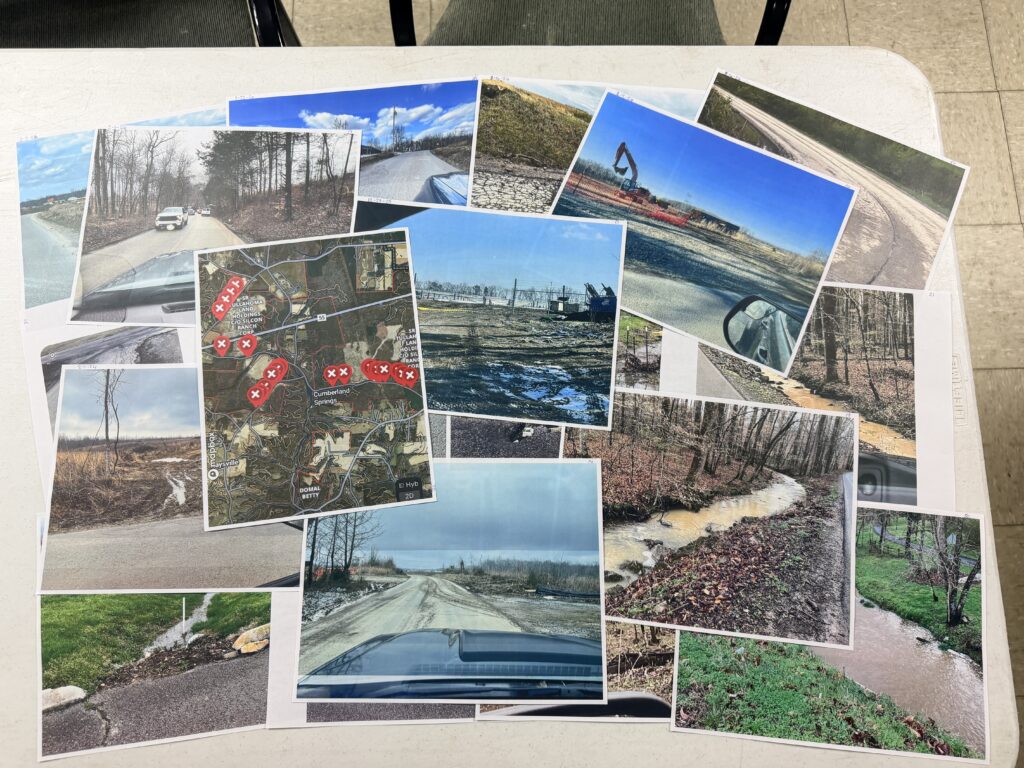
My experience on Highway 55 does not exist in isolation. Consider what the public record shows. Roads Superintendent Shannon Cauble presented photographic evidence to the Metro Council in March documenting that LPL Solar has been operating 29 site entrances along county roads — nearly three times the 11 entrances specified in Silicon Ranch’s approved building permit. That is not a construction complication. That is a company operating outside the boundaries of what it agreed to. The Metro Council voted 10-1 to direct the county attorney to send a formal letter threatening legal action if LPL Solar does not come into compliance.
Separately, a February inspection by the Tennessee Department of Environment and Conservation, triggered by three citizen complaints, documented unauthorized discharges and sediment loss at multiple stormwater basins — and concluded that sediment had likely reached downstream waters. No formal Notice of Violation was issued, and Silicon Ranch has said corrective work is underway; I reported that when the findings were released, and fairness requires I say it again here. But a state agency concluding that sediment probably reached Hurricane Creek is not a clean bill of health. Add to that the near-miss on a busy state highway that prompted a call to law enforcement — who told me they had received a similar complaint the day before — and you have four documented categories of harm: road damage, permit violations, environmental discharge, and traffic safety. Each recorded by a separate authority. Again, that’s not coincidence. That’s a pattern of choices and behavior.
In my personal life and journalistically, I operate by the three strikes rule. It’s a boundary that honors my nervous system, which is the key to health and longevity. Communities also possess collective nervous systems, and actions that cause stress, drama, and controversy — whether intentional or not — amount to harm.
Once could be an innocent mistake — construction is hard, timelines are brutal, and reasonable people extend grace. Twice can be chalked up to a nuisance, the kind of thing you flag and monitor and hope corrects itself. Three and four instances establish a pattern. Muddy roads are one thing. Storm water runoff and sediment in a beloved local water way are another. But I cannot ignore a willful choice that risks any human life.
The driver who pulled that semi across Highway 55 without adequate clearance made a choice — not a mechanical failure, not an act of weather, a choice — and choices like that one have a way of ending badly when the reaction time on the other end belongs to a teenager, or an elderly driver, or anyone momentarily distracted by life. I have a responsibility to this community that predates my tenure at this paper and will outlast it. Staying silent because the subject matter is complicated, or because I have tried to be fair to this project in my news coverage, or because speaking plainly might make someone uncomfortable — that would be journalistic malpractice.
Constructing a 3,400-acre solar farm on Tennessee wetland is not a tidy process. I understand that, and I am willing to extend a great deal of grace for the ordinary mess of large-scale construction. What I am not willing to accept is unnecessary risk — the kind that could land one of my family members, friends, or neighbors in the hospital or funeral home.
Except for my years at Tulane University and the University of Alabama, I am a lifelong resident of Lynchburg. I have covered this community as a journalist for more than 20 years. When I say “my citizens,” I mean it the way you mean it when the community is not just where you work, but where your family has lived for generations. You do not get to take unnecessary chances with those lives and call it neighborly.
Silicon Ranch and LPL Solar have an opportunity to make good on the commitment they have made publicly, repeatedly, and on record. The Metro Council vote, the TDEC findings, and law enforcement reports all exist as public records. What happens next is a choice Silicon Ranch and LPL Solar get to make — and one that the people of Moore County are watching closely. •
About the Lynchburg Times: The Lynchburg Times is Moore County’s locally owned, independent news source. Our reporting is supported by readers, small business partners, and corporate underwriters. If this story was valuable to you, consider becoming a supporter at lynchburgtimes.com.