
By Tabitha Evans Moore
Editor & Publisher
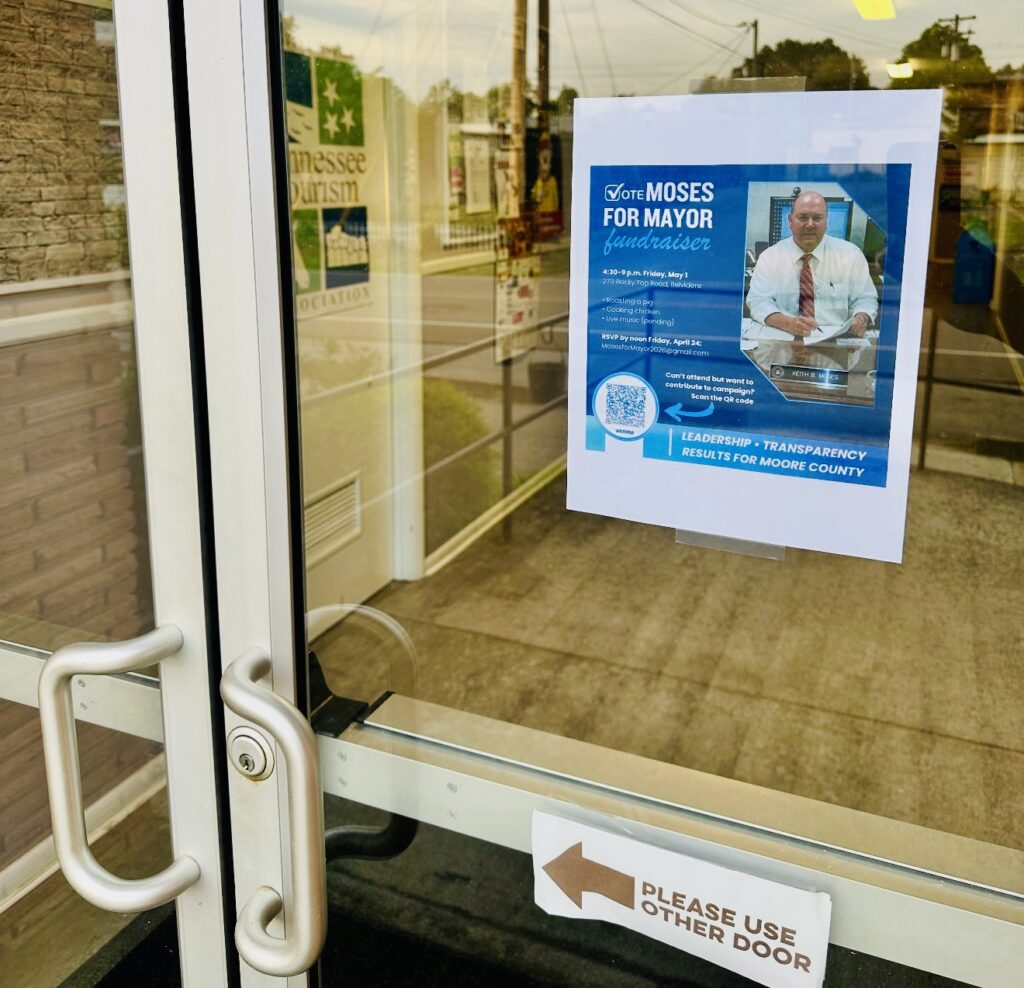
LYNCHBURG, Tenn. — Earlier this week, a local sources reached out to The Lynchburg Times about a political sign posted on the front door of the Moore County Building at 241 Main Street — the District 1 polling place and Moore County’s early voting site. The sign promoted a May 1 fundraising event for mayoral candidate Keith Moses.
{Editor’s Note: This article was originally published on Thursday, April 30 and updated on Friday, May 1 to include new details. }
Under Tennessee law, that could be a problem.
State law T.C.A. § 2-7-111 establishes a 100-foot campaign-free zone around any polling place, active on Election Day and throughout early voting. Within that zone — and inside the building itself — campaign posters, signs, literature, and any solicitation of votes are strictly prohibited. A fundraiser flyer for a declared mayoral candidate is campaign material by any reasonable reading of the statute. The law makes no exception based on whether a candidate currently appears on a ballot.
There is a second statute at issue as well. T.C.A. § 2-19-119 makes it unlawful to use public buildings or facilities for campaign activity in support of any particular candidate unless reasonably equal access is provided to all sides. The standard isn’t an outright ban — but equal access to a public building must be guaranteed. There is no indication that was the case here.
On Friday, we spoke to Lorraine Carter of the Moore County Election Commission who told us that personally she didn’t feel political signs were appropriate for public buildings at any time, but that the Moses fundraising sign was technically okay because there was no active election activities happening. Moore County chose not to open up early voting for the Primary Election since there was only one name on the ballot.
Carter also explained that because Moore County does not currently have an active Republican Party Executive Committee, there was not a local organization that could have opted Moore County out of the state-called Republican Primary. That election will cost taxpayers around $30,000 though Carter says the state will reimburse Metro for the expense.
Sanders says sign was “okay for now.”
Earlier in the week, The Times contacted both Moore County Elections Commissioner Jim Sanders and candidate Moses.
Commissioner Sanders responded that because Moses does not appear on the May Primary ballot, the sign was acceptable “for now.” That reasoning did not hold up against the plain language of the statute. T.C.A. § 2-7-111 governs the building and its designated boundary — not the ballot status of any particular candidate. However, since there was no early voting period in play, it creates a reasonable gray area.
Candidate Moses told The Times he distributed numerous flyers but did not post anything at the County Building.
“Since you have copied Mr. Sanders on your email, I am sure he will remove the flyer at his earliest convenience,” Moses said.
The sign was — in fact — removed before noon Wednesday. It is unclear who posted it and who removed it. Carter said she did not direct anyone to remove the sign, and she’s not sure who removed it.
The Times also contacted the Tennessee Secretary of State’s office for clarification on the applicable statutes and the local office’s interpretation of them. We are awaiting reply.
A note on the broader law
Tennessee’s election signage rules carry important nuances for candidates and residents heading into election season.
The 100-foot campaign-free zone applies equally on Election Day and during early voting. Enforcement at early voting sites falls to election commission staff — meaning consistent application across multiple weeks and potentially multiple locations depends entirely on the diligence of local officials.
A 2017 state law, the Tennessee Freedom of Speech Act (T.C.A. § 2-7-143), protects private property owners’ rights to display political signs beginning 60 days before any election through the day after the next subsequent election. Local governments cannot regulate the shape or quantity of those signs, though size limits apply — 32 square feet for commercial property, 16 square feet for residential. Signs on public rights-of-way and utility poles remain prohibited statewide.
Candidates are responsible for removing signs within three weeks after an election, but there is no penalty for failing to do so.
The voter registration deadline for the upcoming election is Tuesday, July 7, and early voting will begin Friday, July 17, and extend through Saturday, Aug. 1. Absentee ballots must be requested by Monday, July 27. The Moore County General Election will take place Thursday, Aug. 6. •
About The Lynchburg Times: The Lynchburg Times covers Moore County elections as part of its commitment to community accountability journalism. This work is supported by readers, small business partners, and corporate underwriters.