
By Tabitha Evans Moore
Editor & Publisher
LYNCHBURG, Tenn. — For more than a year, Moore County officials and Gateway Development Corporation have talked past each other about apartments, townhouses, zoning ordinances, and court filings. Tuesday night, commission member Scott Fruehauf cut through it: “It’s a density issue that’s been the problem the whole time.”
That single sentence may have done more to clarify eighteen months of conflict than anything that came before it — including the five-page legal brief Gateway’s attorney submitted to the commission the day before the meeting, a document that cited case law, walked section by section through the Metro Zoning Ordinance, and arrived with a message that was anything but subtle: approve this, or see you in court.
It was that kind of evening.
{Editor’s Note: Public meeting coverage is crucial to the health of any community. This article remains free to all readers thanks to reader support and our community partners at Barrel House Barbecue. Please support the local small businesses that support your community newspaper.}
A LETTER WRITTEN FOR THE RECORD
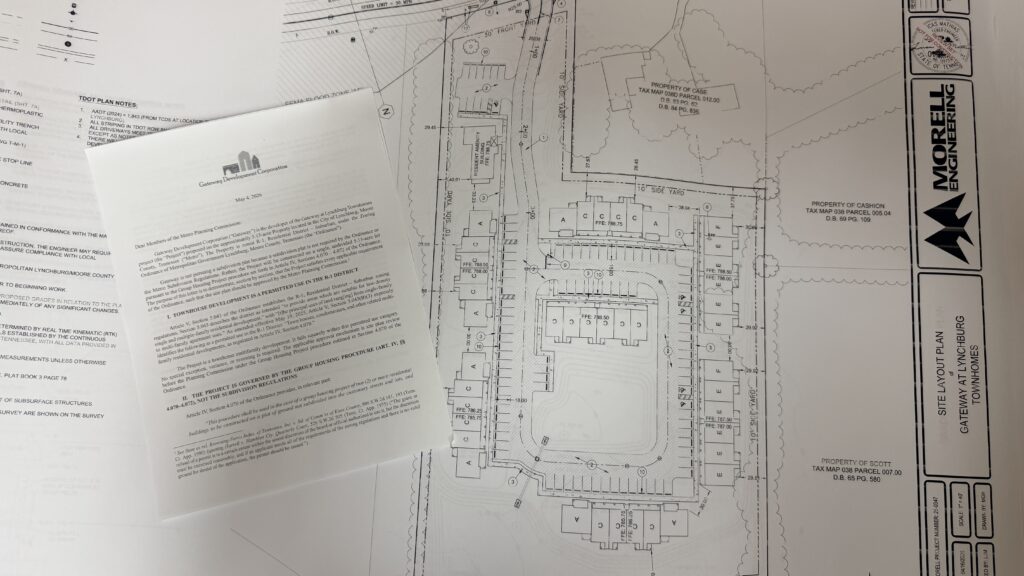
Gateway Development Corporation arrived at Tuesday’s meeting armed with something unusual: a five-page legal brief addressed to the Planning Commission — a document whose tone made clear it was written as much for a future courtroom as much for Tuesday’s Planning & Zoning Commission’s meeting.
The letter, submitted May 4 by Gateway representative Josh Mandell, walks section by section through the Metro Zoning Ordinance, arguing that its proposed 42-unit townhome development on a 5.13-acre parcel along Main Street satisfies every applicable standard. It cites case law, and preemptively rebuts objections. It is, in the language of land-use litigation, a paper trail in the making.
Gateway also requested that the Planning Commission forward the letter to all Metro Council members on the company’s behalf. The commission forwarded that email on Tuesday morning.
The legal framing is unmistakable: if the commission denies the site plan, Gateway wants the record to show it raised every argument in advance. The Tennessee Court of Appeals has long held that when an applicant meets all applicable zoning requirements, denial becomes legally arbitrary — a principle Gateway underscored by citing State ex rel. Browning-Ferris Industries of Tennessee, Inc. v. Board of Commissioners of Knox County (1990) in the letter’s opening footnote. That case established that permitting boards cannot exercise unlimited discretion to deny compliant applications.
The Browning-Ferris citation is meant to carry weight here. Gateway has already sued Metro Moore County once over this property. That lawsuit is still pending in Moore County Chancery Court. In February, Judge J.B. Cox denied Gateway’s request to immediately invalidate a zoning amendment approved by Metro Moore County officials, allowing the lawsuit challenging the amendment to continue and declining to rule in Gateway’s favor at this early stage of the case. There have been no additional filings since February.
A YEAR OF DISPUTE
The Gateway at Lynchburg project has been entangled in legal and procedural conflict since early 2025. The Alabama-based developer originally proposed a 42-unit affordable housing complex funded through federal Low-Income Housing Tax Credits (LIHTC). On April 2, 2025, Metro Mayor Sloan Stewart signed a letter confirming that apartments were permitted under the parcel’s existing R-1 zoning classification.
Three weeks later, the landscape shifted. On April 21, 2025, the Metro Council — approved a zoning amendment that removed apartment dwellings from the R-1 district, imposed new minimum lot-size requirements, and capped multi-unit developments at 25 units.
During that meeting, Planning Chair Dexter Golden — who also sits on the Metro Council — told the Council that water capacity was his primary concern, saying the system was running at roughly 75 percent of capacity and that unmanaged growth could force costly infrastructure upgrades — arguing that tighter zoning standards would give the county time to plan.
He also said he wanted to move apartments out of R-1 into a commercial zone because most surrounding counties handle it that way, and because apartments — unlike townhouses or condominiums — are typically renter-occupied and company-owned rather than individually held.
“We’ve had some developers reach out about apartments,” Golden said. “Nothing’s in front of us. No permits issued, no site plan. But that is some things to consider.”
The original motion combined three things: moving apartments from R-1 to C-1, doubling the square footage requirements, and adding a 25-unit cap per development. Notably, that cap came at the suggestion of fellow council member Robert Bracewell and not Golden. The April first reading vote was 11 yes, 4 no. The amendment passed on second reading May 19, 2025, by a vote of 10–5. There was also a public meeting on the proposed change prior to the May meeting.
Gateway argues the changes were engineered specifically to block its project, which required 42 units to meet LIHTC program standards.
Gateway filed suit on November 7, 2025, in Moore County Chancery Court, arguing the amendment was adopted without proper public notice and in violation of Tennessee’s Open Meetings Act, rendering it void ab initio — legally, as though it never existed.
In December, Gateway representative Troy Woodis appeared before the Planning Commission for the first time since the lawsuit was filed, seeking to understand why a site plan submitted October 22 had been removed from the December agenda. Commission Chair Golden stated that county attorneys had instructed the board to communicate only through legal counsel while litigation was pending.
In January 2026, Gateway filed a Motion for Judgment on the Pleadings, asking the Chancery Court to rule immediately that the ordinance was invalid. On February 10, Chancellor J.B. Cox denied the motion, finding that disputed factual questions — including whether proper public notice was published — could not be resolved at that early stage. The court did note that a notice published in The Lynchburg Times on April 23, 2025 met both state and local timing requirements, partially undermining one of Gateway’s arguments. The zoning amendment remains in effect, and the lawsuit continues.
Now Gateway has returned with a different approach entirely.
A NEW STRATEGY: TOWNHOUSES, NOT APARTMENTS
Rather than continuing to press solely on whether the 2025 zoning amendment was lawfully adopted, Gateway’s May 4 letter pivots to a separate argument: that its proposed development qualifies as a townhome project — not an apartment complex — and is therefore permitted by right under the amended ordinance itself.
The argument hinges on a May 19, 2025 amendment to Article V, Section 5.043(B)(3) of the Zoning Ordinance, which expressly added townhouses, condominiums, and other related multi-family residential developments as permitted uses in the R-1 District, governed by the Group Housing Project procedure set forth in Article IV, Sections 4.070–4.072.
Under the Group Housing procedure, a developer can construct multiple residential buildings on a single, undivided parcel without filing a subdivision plat. The Planning Commission serves as the reviewing agency.
Gateway’s letter argues that all 42 proposed units satisfy the Group Housing standards: the site abuts Main Street, density calculations meet R-1 requirements, setbacks are satisfied, parking exceeds the minimum, and the site plan — certified by a licensed engineer — includes all required elements.
WHAT THE ORDINANCE SAYS ABOUT TOWNHOUSES
The Commission’s definition of townhomes possesses language that Gateway’s letter does not fully reckon with.
The definitional dispute played out in real time Tuesday. Commission Chair Golden read the townhouse definition aloud to the room, then stated plainly what he and county attorney Bill Reider had concluded: the six-unit structures shown on Gateway’s site plan did not qualify.
Gateway attorney Haynes pushed back, arguing each structure contains one dwelling unit per door — one kitchen, one household — attached in a series, which she said fits the definition precisely.
There seemed to be a disconnect.
The Metro Zoning Ordinance defines a Town House as: a building, located upon one zone lot, containing not more than two dwelling units, attached at the side or sides in a series of three or more principal buildings each containing not more than two dwelling units. At points of attachment, such buildings shall be separated from each other by fire walls extending from footings through roofs without openings.
That language creates a problem for Gateway’s strategy. There is a quiet but significant conflict buried in the ordinance’s own language. The Metro Zoning Ordinance defines a Town House as a building located upon “one zone lot” — meaning each individual townhouse structure is contemplated as sitting on its own separate parcel of ground. That assumption is foundational to the definition: individual buildings, on individual lots, with fire walls between them.
Gateway’s strategy, however, rests entirely on the opposite premise — that the 5.13-acre property remains a single, undivided parcel, which is the basis for using the Group Housing procedure that allows the development to bypass subdivision requirements.
In other words, Gateway is simultaneously claiming the land use category of “townhouses” — which the ordinance defines in terms that presuppose individual lots — while arguing it is exempt from the subdivision process that would create those lots. The ordinance may not be able to accommodate both positions at once. If the commission’s attorney concludes that the townhouse definition and the Group Housing procedure are internally incompatible as Gateway has applied them, the project’s permitted-use argument could unravel regardless of whether every other development standard is met.
Under Metro’s definition, each townhouse building in a qualifying development may contain no more than two units. With 42 units proposed, Gateway would need a minimum of 21 separate two-unit structures — each separated by a compliant firewall — to satisfy the ordinance’s own definition of the use it is claiming.
The firewall requirement is not incidental. Fire walls extending from footings through roofs without openings are a construction standard that affects both building design and cost. They exist to prevent fire from spreading between attached units — a life-safety provision. Whether Gateway’s submitted plans meet that standard is a question the commission and its third-party engineer would need to evaluate.
Metro Attorney Bill Reider ultimately framed it as the dispositive question: until the two sides reach agreement on the definition of townhouse, he said, there was nothing further the commission could do. Gateway cannot be added to the June agenda, he indicated, until that definition is resolved.
“Mr. Chairman, that presupposing that their definition of townhouse is correct. There is disagreement on that premise,” he said.
THE HALF ACRE FLASHPOINT
Gateway’s letter dedicates a full section to rebutting concerns that each townhome unit must sit on a half-acre lot — a standard that would make a 42-unit development on 5.13 acres mathematically impossible. A half-acre lot is smallest lot size allowed in R-1.
The half-acre language appears in Section 5.043(E)(4) of the Zoning Ordinance, which states that lots in Urban Service areas will be no less than half-acre lots. Gateway argues this standard applies only to subdivided lots and has no bearing on a Group Housing project, where the property remains a single undivided parcel. Applying the per-unit standard to a group housing development, Gateway contends, would render Section 4.070 meaningless.
Golden made his own math explicit Tuesday night. Reading the half-acre minimum alongside the two-unit-per-building definition, he said he had consulted with local developers and concluded the parcel could support no more than 20 townhome units under the ordinance as he reads it.
“If you do the math on that, I believe that comes out to twenty townhomes,” he said.
A DEVELOPER WITHOUT A DEED
Notably, Gateway Development Corporation has not purchased the property at the center of this dispute. A check with the Moore County Property Tax Assessor confirms that as of this week, the parcel remains under its current ownership — not Gateway’s.
That is a significant detail in any vested rights analysis. Vested rights in Tennessee land use law generally require that a developer has made substantial expenditures in reliance on existing zoning. Ownership of the subject property could be foundational to that claim. Whether the commission or its legal counsel addresses Gateway’s standing to seek site plan approval on land it does not own remains to be seen.
It also raises questions about the LIHTC funding that originally drove the project’s 42-unit requirement. Federal Low-Income Housing Tax Credit allocations operate on competitive, time-limited cycles.
According to a July 30, 2025 preliminary ranking issued by the Tennessee Housing Development Agency, Gateway at Lynchburg was awarded a funding reservation under the state’s competitive Low-Income Housing Tax Credit program. The Moore County development, listed as THDA #25-030, was allocated $1,153,998 in tax credits. THDA’s memo notes that underwriting was already underway at the time of the ranking.
THE LOW INCOME QUESTION
The meeting’s sharpest moment came when both Gateway attorney Haynes and Woodis suggested the commission’s resistance might have less to do with ordinance definitions than with the nature of the development itself.
“Is it just because it’s this development?” she asked. “And what other reason is there?”
Later, Woodis was more direct: “I also know that the word on the street and in the papers is still that we’re a Section Eight developer, and everybody’s worried about us bringing Section Eight housing in here.”
{Editor’s Note: The Lynchburg Times has never referred to the Gateway project as “Section Eight” housing in any of our coverage.}
Woodis pushed back on that characterization of his tenants.
“We are not a project-based Section Eight developer,” he said. “We’re an affordable housing developer. Our tenants are firefighters, police officers, single moms that didn’t want to be single moms. College students that want to come back home and start a career.”
Commission members rejected the implication firmly.
“Madison, that is nothing this board has said,” Chair Golden told her. “You are putting those words in our mouth. We have not ever said that.”
Multiple members reiterated that the dispute centers on the definition of townhouse and the density issue nothing else.
Commission member Scott Fruehauf offered what may be the clearest summary of the county’s position. “Nobody’s ever said you couldn’t come in and build any apartments,” he said. “Nobody’s ever come in and said you couldn’t build any townhouses. We’re open to apartments. We’re open to townhouses. It’s a density issue that’s been the problem the whole time. It’s not Moore County shutting down apartments. It’s been a density issue.”
MAYOR STEWART STEPS IN
As Haynes and Woodis pressed on why an application and check had been refused by the local Planning office, Mayor Sloan Stewart stepped to the front of the room and was direct about his own role — and his own authority.
“I denied the application,” he told the room — explaining that he had instructed the planning office not to accept Gateway’s application when Woodis arrived on April 21 with a check and paperwork in hand. His justification was not the zoning ordinance. It was the Metro Charter. “My book comes before their book.”
Stewart further explained that his job to minimize harm to existing citizens, protect them from unreasonable tax increases that might result from growth that happens too quickly resulting in steep infrastructure costs.
“I don’t look at the individual, I don’t look at the subdivision. I don’t look at the townhome. I look at what it’s going to cost us as a county,” he explained. “When you talk about the book, my book’s in my office and it’s what I have to go by. They come under me. The charter is my Bible.”
The distinction matters legally. Gateway’s entire argument rests on the zoning ordinance — the book Reider, Golden, and the commission have been debating all evening. Stewart was asserting that a separate document, the Metro Charter, gave him independent authority to weigh the cost to the county before an application ever reached the commission. Gateway’s attorney did not directly respond to that claim on the record.
Stewart was careful to separate the decision from any personal animus toward Woodis stating that he’d known him personally for several years.
INFRASTRUCTURE CONCERNS
Beyond the legal and procedural questions, a 42-unit development carries tangible infrastructure implications for a small community.
The commission heard from four community voices on infrastructure Tuesday, each raising concerns that extended well beyond Gateway’s specific application.
Moore County Schools Superintendent Chad Moorehead told the commission that enrollment has climbed steadily after hitting a low of around 750 students several years ago, and now stands at approximately 865. This school year alone, the district added 44 students — nearly the equivalent of an entire graduating class in a system with grade cohorts of 65 to 75.
“By the time we get up over a thousand and hit, especially 1,100 and above, we’re really going to be cramped for space in our buildings, especially at the elementary school where class sizes are more limited,” Moorehead said.
He noted that the state funding formula follows students, generating more than $600,000 in additional state funding for next year — but that state funding does not cover the cost of new construction or building expansions.
Fire Chief Hunter Case framed the fire protection question in terms of ISO ratings and water availability. Forty percent of a community’s ISO rating is tied to water supply, he said, and any engineering assessment of a new development would need to confirm whether the system’s reserve capacity — above daily demand — could meet the required fire flow for that type of structure. The county’s volunteer fire department, Golden noted, is already stretched: “We don’t have people knocking down the door at the volunteer service to help.”
MUD Manager Ronnie Cunningham, who appeared briefly, confirmed that the county’s water lines in town run six to eight inches — adequate for fire suppression. His appearance stood in contrast to statements he made before the Metro Council in 2025, when he told members the system could absorb current growth, with the caveat that a significant expansion by Jack Daniel’s Distillery could create capacity constraints.
Golden pressed Cunningham directly Tuesday, asking at what capacity the system currently operated. Cunningham confirmed it was 75 percent. Golden followed up, asking at what percentage the state requires a community to begin a 10-year water infrastructure upgrade plan. Cunningham confirmed it was 80 percent — effectively acknowledging a five percent margin between where Moore County stands and where the state compels action.
“Y’all are in the business of selling taps,” Golden told Cunningham from the dais. “I get it; y’all need to pay bills.”
Haynes pushed back stating that the addition tax revenue would help pay for any additional infrastructure needs.
“That is the that’s how this works, right? It’s the budgeting. They pay water fees. They pay taxes. They pay their water bill. They pay their electric bill. They pay the property taxes that support schools.”
Golden pushed back, “I would encourage you or anybody else that believes that to call Rutherford County and see how much lower their taxes got with the growth.”
According to WKRN News 2, Rutherford County approved a 16 percent property tax increase in 2023 in order to satisfy a $64 million budget shortfall —largely caused by explosive growth. That year, the Rutherford County Commission approved their largest property tax increase in nearly 30 years.
Road Superintendent Shannon Cauble raised perhaps the most immediate concern. Main Street already has approximately 70 new units in development at the Retreat at Whiskey Creek, she said, with roughly 90 expected. Adding Gateway’s 42 units to that corridor, she said, could mean a 30 percent or greater increase in traffic.
“I am very concerned that we just don’t have the infrastructure,” Cauble said.
WHAT HAPPENS NEXT
Tuesday’s meeting ended without a vote and without a formal application on file. Mayor Stewart’s admission that he had instructed planning not to accept Gateway’s paperwork in April left the procedural path forward murky. Commission members indicated a willingness to accept an application, but county attorney Reider stated the townhouse definition dispute must be resolved first — and that if the commission’s reading prevails, Gateway’s plan as submitted does not comply.
Gateway attorney Haynes indicated the team would return, either to file an application with the Metro Planning office or to appear at the June meeting. The underlying lawsuit — Gateway at Lynchburg, LP v. Metropolitan Government of Lynchburg-Moore County — remains pending in Moore County Chancery Court.
The Metro Planning Commission meets on the first Tuesday of every month at 5:30 p.m. at the County Building. •
About the Lynchburg Times: The Lynchburg Times is Moore County’s locally owned, independent news source. It’s owned by Lynchburg native with over 20 year of experience covering the community. Our reporting is supported by readers, small business partners, and underwriters who believe community journalism matters. If this story was valuable to you, consider becoming a supporter at lynchburgtimes.com.
Leave a Reply
You must be logged in to post a comment.