

By Tabitha Evans Moore
Editor & Publisher
LYNCHBURG, Tenn. — “Nothing much” and “a little dirt in the water” — that’s how Metro Utility Department Manager Ronnie Cunningham described a Tennessee Department of Environment and Conservation (TDEC) Notice of Violation (NOV) regarding water pollution from the Metro Moore County Water Plant into a nearby stream that runs along Good Branch Road to the MUD Board on Tuesday night. The entire conversation took less than two minutes.
“I got one more thing here, nothing much,” he said. “I’ve got this letter from the state talking about the pond. We just got one person that keeps turning us in because they see a little dirt in the water there. I just got to come up with a plan and when we’re doing it.”
MUD’s violation is the latest in a string of water-related compliance issues in Moore County. TDEC inspections in February found both the Moore County Solar CGP construction site, permitted to LPL Solar, LLC, and The Retreat at Whiskey Creek development out of compliance with their stormwater permits under the Clean Water Act. No formal Notice of Violation was issued to either.
Commercial, residential, and municipal —Moore County’s public water seems to be getting hit from all sides.
MUD issued a formal Notice of Violation
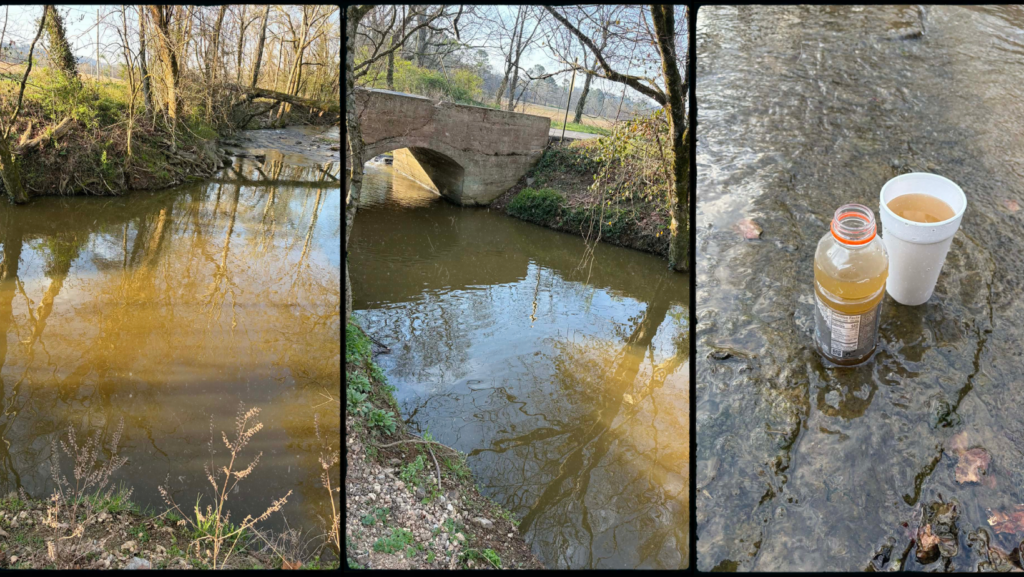
Despite the “nothing much” from Cunningham, the Metro Utility Department (MUD) is facing a formal violation notice from the state after inspectors found muddy, unsettled water flowing from the Metro Moore County Water Plant’s holding basin directly into a local stream that feeds East Fork Mulberry Creek located along Good Branch Road.
The Tennessee Department of Environment and Conservation (TDEC) issued the Notice of Violation (NOV) on May 7, 2026, after two state inspectors visited the site on April 27. The notice was sent by certified mail to Cunningham.
According to the NOV, inspectors found a light brown material suspended in the water of the stream below the plant. As they walked upstream toward MUD’s discharge pipe, the material grew thicker. Inches of the same sediment had settled onto the streambed. When they checked the contents of MUD’s filter backwash basin — the holding pond at the plant — the material inside matched what was in the stream. Upstream of the discharge pipe, the water was clear.
In plain terms: dirty water from the treatment process was going into the stream instead of being properly cleaned first.
{Editor’s Note: This article remains free to all readers thanks to reader support and our community partners at Barrel House Barbecue. Please support the local small businesses that support your community newspaper.}
What’s happening and why it matters
When a water treatment plant cleans its filters, the rinse water — called filter backwash — carries dirt and sediment. That dirty water is supposed to go into a settling basin, where the solids sink to the bottom. Only the clarified water sitting on top is allowed to be discharged into a nearby waterway. MUD’s permit requires that process before any water leaves the plant site.
What inspectors found suggests the basin was either too full, not working properly, or being bypassed — sending unsettled, murky water straight into a nearby stream.
MUD is currently in negotiations with an adjacent property owner to acquire the land necessary to expand the basin, but as of Tuesday’s MUD Board meeting had not yet acquired it.
The stream at Good Branch flows into East Fork Mulberry Creek. Sediment dumped into a stream doesn’t just disappear — it settles on the streambed, smothering habitat for fish and aquatic insects. Over time, repeated discharges can change a stream’s character permanently.
For MUD ratepayers, the stakes are financial as well. Fines for water quality violations can run into tens of thousands of dollars and compound daily. The cost of engineering a proper fix — or expanding the basin — falls to the utility, and ultimately to its customers.
A known ongoing problem
The state’s May 7 notice is not the first time MUD has been put on notice about this problem. According to the violation letter, TDEC held a Compliance Review Meeting with MUD on March 25, 2025 — more than a year ago. At that meeting, MUD submitted a Corrective Action Plan (CAP) laying out steps to manage the basin wastewater.
TDEC says that plan has not worked. The agency is now demanding a revised plan with alternative solutions, specific steps to prevent future violations, and a timeline for carrying them out. The deadline is June 30, 2026.
When asked about the Notice of Violation at Tuesday’s meeting, Cunningham told the board he plans to submit a Corrective Action Plan to TDEC by the June 30 deadline proposing the basin be pumped out and cleaned twice a year. He said he solicited bids for the work, with the lowest coming in around $10,000. A contractor had been scheduled to do the work in April but had not yet completed it at the time of TDEC’s April 27 site visit.
A transcript of the April 14 MUD board meeting shows the basin capacity problem was raised openly before TDEC’s April 27 site visit. A MUD employee told the board during last month’s meeting, “We got issues, y’all. Best do your homework because we get turned in.”
Board members and staff discussed the basin’s physical limitations — hemmed in by Good Branch on one side and neighboring property on the other, with no room to expand. On Tuesday, the board voted to approve the land purchase at an estimated total cost of just over $30,000, to be drawn from savings, though a final price had not yet been confirmed and no closing date was set.
What happens next
MUD has until June 30 to submit a revised Corrective Action Plan to TDEC’s Columbia Environmental Field Office. If the plan is not submitted, or if the state finds it inadequate, the next step could be a consent order — a legally binding agreement that sets specific required actions and can carry daily fines until the problem is resolved. In serious cases, TDEC has the authority to revoke a discharge permit entirely.
The MUD Board meets every second Tuesday of the month at 6 p.m. at the Metro Utility Department offices located at 705 Fayetteville Highway in Lynchburg. There is a public comment period at the beginning of each meeting. To be added to the agenda, contact the MUD offices at 931-759-4297 or metrowatermc@gmail.com. •
ABOUT THE LYNCHBURG TIMES Public meeting coverage is crucial to the citizens of any small town. It matters who’s in the room, what decisions are being made on your behalf, and how those decisions trickle down into everyday life. Our editor, Tabitha Evans Moore, has covered Metro Moore County public meetings for more than 20 years — bringing the institutional knowledge to report them with the nuance that makes local government accessible to every citizen. If you’d like to support our work, you can do so at this link.