

By Tabitha Evans Moore
Editor & Publisher
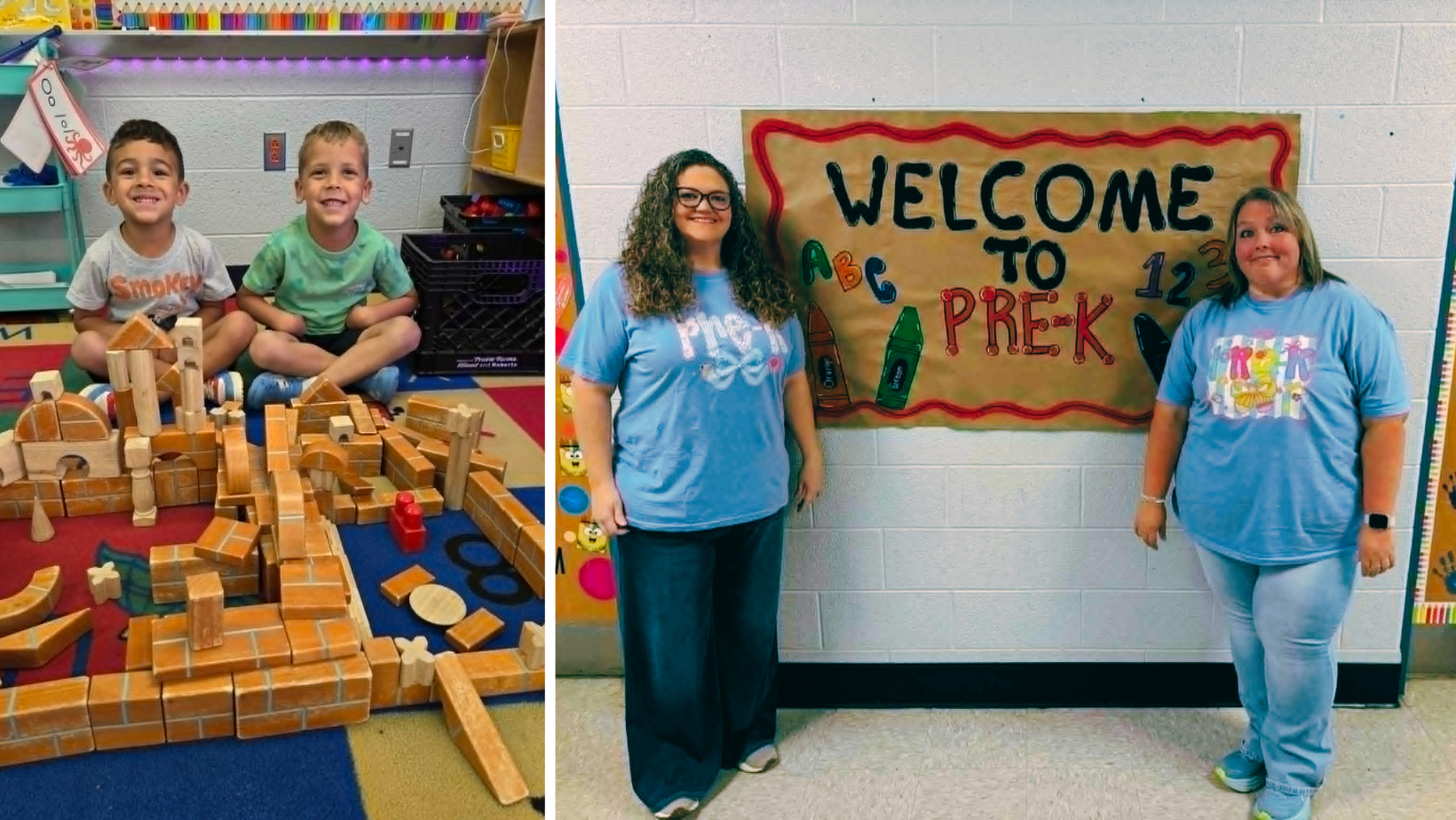
LYNCHBURG, Tenn. — The little boy arrived in Karen Blankenship’s pre-K classroom speaking in one- and two-word sentences. He wasn’t fully potty trained. He would eat only a few familiar foods and play with only one thing — blocks. When other children got too close, he sometimes lashed out, because he had no words to tell them what he wanted.
Two years later, he walked out of her classroom reading simple stories. He had mastered the kindergarten sight word list before he ever set foot in a Moore County kindergarten classroom. He tried new foods — even at home. In two short years, he’d bloomed from a child into a classroom-ready student.
That is what Moore County stands to lose if it can’t fill seven more income-eligible slots this fall.
The Voluntary Pre-K classroom (VPK) at Lynchburg Elementary School needs 18 income-eligible four-year-olds to secure its state funding. As of this week, it has 11. The first day of school is August 7.
GENEROUS INCOME GUIDELINES
Tennessee’s Voluntary Pre-K program pays Moore County Schools $89,053 a year to run its single pre-K classroom, according to Director of Schools Chad Moorehead. The full program costs $133,931 in the 2026-27 budget. The district covers the difference — roughly $45,000 — from its general-purpose budget.
The state’s money comes with a condition: 90 percent of the classroom’s 20 seats must be filled by four-year-olds whose families meet state income guidelines. Ninety percent of 20 is 18. That is where the number comes from.
The income guidelines are more generous than many families assume. A family of four qualifies if it earns $61,050 a year or less. A family of two qualifies at $40,034. Each additional household member raises the limit by $10,508.
“In their head, I think most parents think, well, I don’t qualify for food stamps or anything — so why would I qualify for this?” said Blankenship, who has taught the class since Moore County was first awarded the grant in 2006. “I just think everybody needs to just check. It doesn’t hurt to check.”
A CHANGE IN THE STATE GUIDELINES
Moore County has never had trouble filling the classroom. It has had trouble filling it with families who qualify on paper — and this year, the state took away the tool the district always used to close the gap.
For years, if income-eligible four-year-olds didn’t fill the room by mid-September, the district could enroll income-eligible three-year-olds — just like our success story above — and those children counted toward the state’s enrollment requirement. Beginning this school year, according to Moorehead and Blankenship, they no longer count.
The deeper problem is arithmetic. Moore County’s median household income is roughly $66,000, according to the latest Census Bureau estimates — among the highest in Tennessee, buoyed by payrolls at the Jack Daniel Distillery and commuters to Tullahoma, Shelbyville and beyond. That figure sits above the pre-K income cutoff for a family of four. The state built a program for economically disadvantaged children and set the bar at 90 percent — in a county where the typical household earns too much to qualify.
Blankenship has watched the squeeze tighten from inside the classroom. The past three years, the room hit its numbers only with the help of a few three-year-olds. This year, she said, feels different — and it isn’t just her. The Head Start classroom in Moore County, which serves the same families through a federal program, is also struggling to fill its seats.
Her theory is housing. Families who qualify for the program increasingly can’t afford to live in the county that offers it. She had a four-year-old on her list this year whose mother, a single parent, moved to Fayetteville after finding a place there she could afford to rent. The boy went with her — and so did one of the 18.
Another contributing factor may be the declining U.S. birth rate. According to John Hopkins University, in 2024, the U.S. recorded its lowest ever fertility rate
of 1.6 births per woman, following a downward trend
in fertility rates starting in the early 2000s. There’s a chance that a global trend’s trickled its way down into a Moore County classroom.
WHAT’S AT STAKE
Missing the number does not shut the classroom down on day one. The likely first consequence, Director Moorehead said, is prorated funding — the state pays less until the district meets the income-eligibility threshold. The district must also reapply for the grant every year, and the enrollment numbers are, in Blankenship’s words, the big piece of that puzzle.
But Voluntary Pre-K is not a program the state requires Moore County to offer. If the funding goes, the decision whether to keep it and fund it lands with the school board
If the classroom went away, the alternatives are thin. Moore County has three licensed childcare facilities — Head Start, Little Raiders Preschool and Tanyard Tots. Beyond that, parents would be driving to a surrounding county for private preschool education and likely paying the high price tag that comes with it.
“Kindergarten is not what it used to be,” Blankenship said. “You need to come to kindergarten already knowing your letters and sounds and your colors and your shapes — and how to sit and listen to a story being read. How to answer questions about the story, and how to share and work cooperatively with another student.”
Beyond the academics, she pointed to something harder to measure: twenty families a year who get a teacher in their corner — job postings shared, community resources passed along, parents recruited to volunteer to join the PTO, even to substitute-teach.
“That’s twenty families that won’t be getting those resources,” she said.
The floors at the school were refinished this summer. The furniture is set. Mrs. Blankenship and her classroom assistant, Chastity Glascoe, occupy parts of their summer break with exciting fall plans. There will be a field trip to a pumpkin patch in October, and community helpers visiting — the sheriff’s department, the fire department, EMS. Outside the classroom door, a pumpkin is growing, because Blankenship plants one every year.
The classroom is ready for 20 children. The state is counting to 18. Whether it gets there is now up to Moore County.
DOES YOUR CHILD QUALIFY?
Who: Children who are 4 years old on or before Aug. 15 and live in Moore County.
Income: A family of two qualifies at $40,034 a year or less. Family of three: $50,542. Family of four: $61,050. Add $10,508 for each additional household member. If your children qualify for free or reduced-price school meals, you likely qualify. Children in foster care get automatic admission.
One-income family? Check anyway. Living with grandparents or other family? Check anyway — your household situation may count differently than you think.
The day: Monday through Friday, 7:45 a.m. to 2:15 p.m., free, in the kindergarten hallway at the elementary school. Breakfast and lunch served (free or reduced-price for families who qualify under USDA guidelines). After-care through the extended school program is available at low cost, including during school breaks.
Special needs: Children with IEPs or developmental delays are welcome in the classroom.
What to bring: Birth certificate, proof of a current health exam and immunizations, and income documentation for all adults in the household.
How to apply: Contact Karen Blankenship at karen.blankenship@moorecountyschools.net. •
About the Lynchburg Times: The Lynchburg Times is Moore County’s locally owned, independent news source and the only local media source own by a Lynchburg native. Our reporting is supported by readers, small business partners, and underwriters who believe community journalism matters. If this story was valuable to you, consider becoming a supporter at lynchburgtimes.com.