
By Tabitha Evans Moore
Editor & Publisher
GRUNDY COUNTY, Tenn. — On the morning of March 18, homeowners at The Retreat at Sunset Bluff in Monteagle — sister tiny home communities to the Retreat at Whiskey Creek in Lynchburg — were preparing for a 6 p.m. special meeting to take control of their own homeowners association. That same day, in Franklin, developer Chip Hayes swore out a verified complaint asking a Grundy County judge for a temporary restraining order — to stop the meeting from happening at all.
The restraining order attempt did not stop the vote. The owners met that evening at the Monteagle Community Center, passed a sweeping amendment to the neighborhood’s governing documents by more than the required 67 percent supermajority, elected a homeowner board of directors, and ended Hayes’s authority over the development, according to court filings.
Now the fight has escalated. In a counter-complaint filed July 8 in Grundy County Chancery Court at Altamont, more than 40 Sunset Bluff lot owners are suing Hayes and two of his companies for up to $5 million in compensatory damages plus punitive damages, alleging fraud, self-dealing, unpaid property taxes, and a paper campaign to extend his control of the neighborhood for two years after his legal authority expired. The filing asks the court to pierce the corporate veil and hold Hayes — the Franklin businessman behind the stalled Retreat at Whiskey Creek in Lynchburg — personally liable.
It is the third Hayes tiny-home development in Grundy County to land in court over closely related allegations, following lawsuits by homeowners at The Retreat at Deer Lick Falls in 2024 and The Retreat at Water’s Edge in June.
SUING HIS OWN ASSOCIATION MEMBERS
The original lawsuit presents an unusual alignment: the plaintiffs are the Sunset Bluff Homeowners’ Association itself, Retreat Vacations, LLC, and The Retreat at Sunset Bluff, LLC — and Hayes signed the verification as president of the first, managing member of the second, and managing member of the third. All three entities suing the homeowners are controlled by the same man.
In the sworn complaint, Hayes states that “the only Board Member for the Association is Declarant, The Retreat at Sunset Bluff, LLC” — a company the Tennessee Secretary of State had administratively dissolved seven months earlier, on August 11, 2025.
The homeowners’ counter-complaint argues the association “is not properly aligned as a plaintiff against its own members” and asks the court to recognize the homeowner board elected in March as the association’s rightful voice.
SOLD FUTURE INCOME TO A “CASH ADVANCE” FIRM
The court file lays out a sequence of transactions in the weeks after the dissolution that now sits at the center of the case.
In mid-September — five weeks after the state dissolved the declarant entity — the Hayes-controlled association signed an Exclusive Short-Term Rental Management Agreement with Retreat Vacations, Hayes’s rental company, according to the original complaint. The contract runs five years and made Retreat Vacations the only rental manager owners could use, other than managing a rental entirely themselves with no third-party help.
A day later, by the complaint’s own account, the dissolved declarant recorded a new Amended and Restated Declaration for the subdivision. Among its provisions: a newly defined “Declarant Board Control Period” running from November 12, 2025 — the date everyone agrees Hayes’s original declarant control ended — until November 12, 2027, during which the dissolved declarant would still appoint three of the association’s five directors.
In other words, according to the homeowners: a company that legally existed only to wind down its affairs recorded a document granting itself two more years of board control and locked its sister company into a five-year exclusive contract with the association it controlled.
Then, in late October 2025, Hayes signed a “Sale of Future Receipts Agreement” with Samson MCA LLC, a New York merchant-cash-advance firm. Samson paid Retreat Vacations $110,000 up front — about $107,000 after fees — in exchange for $140,800 of the company’s future revenue, collected by automatic weekly bank drafts. Hayes signed as CEO and as personal guarantor. A merchant cash advance is a form of high-cost financing in which a business sells a slice of its future sales for immediate cash, often used by businesses that cannot qualify for traditional bank loans.
The timing matters because the exclusive rental contract is the revenue. The original complaint’s central damages claim is that losing exclusivity would cause “immediate harm” to Retreat Vacations — the same future income the company had already sold a share of to Samson.
LIEN NOTICES, STOP PAYMENTS, AND UNPAID TAXES
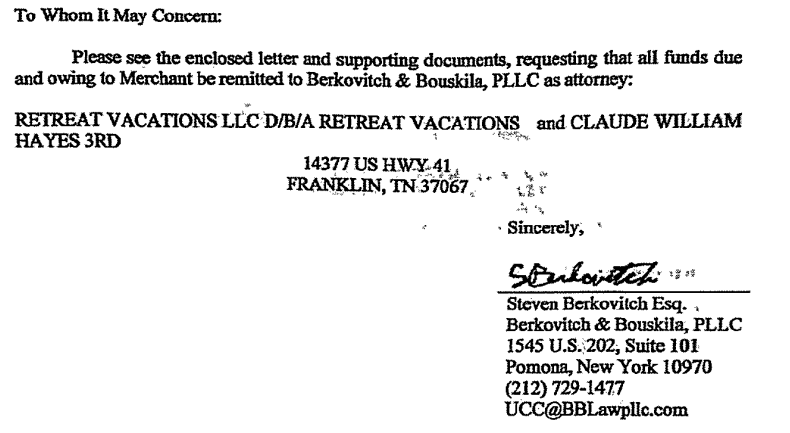
By June 15 of this year, Samson’s representatives had filed UCC financing statements with the Tennessee Secretary of State claiming a security interest in all present and future accounts of Retreat Vacations and a related entity, Retreat Construction LLC. Ten days later, an attorney for Samson sent lien notices asserting Retreat Vacations “has ceased making remittances,” demanding that anyone owing the company money pay Samson directly, and warning that payments made to Retreat Vacations after notice could expose the payer to double liability. The notices put the unpaid balance at $80,960.09.
The homeowners attached the lien materials to their counter-complaint as evidence that the company positioned as the exclusive rental manager inside Hayes’s developments — including at Whiskey Creek — has created competing claims on money flowing through their neighborhood.
As at Water’s Edge, the counter-complaint alleges Hayes’s entities collected assessments from owners while letting property taxes on the neighborhood’s common areas go unpaid. County tax records attached to the filing show declarant-owned common-area parcels with unpaid taxes for 2023, 2024, and 2025. The delinquency grew serious enough, the filing states, that certain common areas were scheduled for tax sale by the Grundy County Clerk and Master — until the lot owners, working with the property management company, paid the delinquent taxes themselves to prevent the sale.
THE LEGAL TIMELINE
Aug. 11, 2025 — Tennessee Secretary of State administratively dissolves The Retreat at Sunset Bluff, LLC.
Sept. 15, 2025 — The Hayes-controlled association signs a five-year exclusive rental management contract with Retreat Vacations, per the original complaint.
Sept. 16–18, 2025 — The dissolved declarant records a Restated Declaration extending its board control to November 2027.
Late Oct. 2025 — Retreat Vacations sells $140,800 in future receipts to Samson MCA for $110,000; Hayes signs a personal guaranty.
Nov. 12, 2025 — Period of Declarant Control ends — a date both sides accept.
Feb. 10, 2026 — Counsel for more than 10 percent of owners formally calls a special meeting through property manager Ghertner & Company.
March 18, 2026 — Hayes swears out a verified complaint and TRO request in Franklin; that evening, owners meet, pass the Fourth Amendment past the 67 percent threshold, and elect a homeowner board.
June 15–25, 2026 — Samson files UCC liens and sends notices asserting an $80,960.09 unpaid balance.
July 8, 2026 — Homeowners answer and counter-sue for up to $5 million.
EIGHT COUNTS AND A FAMILIAR PATTERN
The counterclaims run eight counts: declaratory judgment, breach of the governing documents, breach of fiduciary duty, piercing the corporate veil, misrepresentation and fraud in the inducement, violations of the Tennessee Antitrust and Trade Practices Act, violations of the Tennessee Consumer Protection Act, and injunctive relief requiring a full turnover of association records, funds, and bank accounts, plus a complete accounting.
The fraud and consumer-protection counts echo the Water’s Edge case nearly clause for clause. Marketing materials attached to the filing promised bluff-side views, hiking trails, community pavilions, a playground, and a “Saltwater Pool (Coming Soon)”; a developer-issued timeline projected the pool for spring 2024. The pool was never built, the filing alleges, trails were never completed, and buyers were promised access to amenities at Hayes’s other developments — Water’s Edge and Deer Lick Falls — that likewise never fully materialized.
The March amendment also struck the exclusivity provision at the heart of Hayes’s original suit, guaranteeing owners the right to hire any rental manager they choose. Hayes’s complaint calls that change an anticipatory breach of contract that would “mislead” owners “into contracting with another ‘Hosting Service’ other than Retreat Vacations, LLC.”
In Moore County, Hayes’s Retreat at Whiskey Creek remains stalled amid zoning litigation, a technical road review, and state licensing complaints documented in previous Lynchburg Times reporting.
The Sunset Bluff homeowners are represented by Thomas K. Austin of Austin, Davis & Mitchell in Dunlap. The Hayes entities are represented by Tyler R. Moffatt of Mountain City and Erica R. Chessor of Henry, McCord, Gabriel & Chessor PLLC in Tullahoma.
All claims in both the complaint and counter-complaint are allegations. No judge has ruled on the merits of either side’s case. The Times will continue to monitor the Grundy County cases closely.•
About the Lynchburg Times: The Lynchburg Times is Moore County’s locally owned, independent news source and the only local media source own by a Lynchburg native. Our reporting is supported by readers, small business partners, and underwriters who believe community journalism matters. If this story was valuable to you, consider becoming a supporter at lynchburgtimes.com.
Leave a Reply
You must be logged in to post a comment.