

By Tabitha Evans Moore
Editor & Publisher
LYNCHBURG, Tenn. — Slow and steady growth is the stated goal of the Metro Planning & Zoning Commission and on Monday night, the Metro Council seemed to be in lock step with the Commission as it failed to approve a developer rezoning request based on uncertainty over the use of the entire parcel plus road safety concerns.
The 13 members of the Council present voted 11-2 against a rezoning request for a proposed subdivision on Tanyard Hill Road.
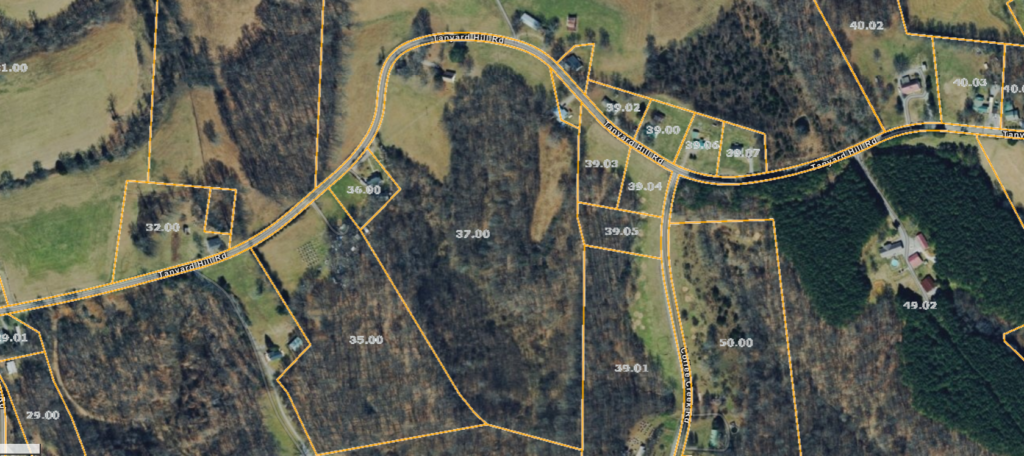
The land in question is a 23.25-acre tract at 3152 Tanyard Hill Road, listed under tax map 037. It is owned by Joe Denby, doing business as Denby’s J&J Construction. The property is currently zoned A-1, agricultural. Under a rule the Council passed in February 2024, agricultural land must be divided into building lots of at least five acres.
That change followed public pushback over an earlier Denby project on the same road, where citizens raised concerns at a 2023 meeting about traffic, water pressure, and septic runoff near local springs and wells.
The purpose of the proposed change local officials stated at the time wasn’t to stop growth but rather slow it by forcing major subdivisions who wish to build on smaller tracts of land spaced more closely together into the rezoning process and in front of the Metro Council where citizens will get more opportunities to be heard and voice objections.
On Monday, Denby asked the council to rezone the property from A-1 to R-2, residential. R-2 zoning allows lots as small as one acre.
Planning and Zoning Commission Chairman Dexter Golden — who also holds a Metro County District 3 seat — told the council that about 13.89 acres of the tract is too steep to build on. Denby officials stated in the July Planning meeting that they plan to gift the property to a neighbor who owns goats. That would leave about 9.36 acres open for development. Golden said Denby was asking for six house lots along the road with a seventh previously built home located directly behind lot 6. Because R-2 zoning allows one-acre lots, some council members noted the remaining acreage could allow more homes than the seven currently proposed if the land is divided further in the future.
{Editor’s Note: Public meeting coverage is crucial to the health of any community. This article remains free to all readers thanks to reader support and our community partners at Barrel House Barbecue. Please support the local small businesses that support your community newspaper.}
JULY 17 SPECIAL-CALLED MEETING
Planning officials act in a purely advisory role and do not possess independent authority to rezone properties in Metro Moore County. They simply analyze rezoning requests to ensure they align with the community’s master plan, which in this case is the Metro Zoning Ordinance. Because the land in question sits in A-1 (agricultural), which currently requires a five-acre building lot minimum, the Commission seemed conflicted about recommending nonconforming lots to the Council, and originally declined to make a recommendation, which is unusual.
At the regular July 7 meeting, Golden explained his thinking by pointing out that this was a new kind of case for the commission — the first major subdivision that needed a rezoning under the county’s February 2024 five-acre rule. Because of that, he wanted to keep the two questions separate: whether the property could be rezoned at all, and what the actual subdivision layout should look like once it was. He stated that his concern was that if the commission gave any kind of positive signal on the layout — even informally — before the council had ruled on the zoning itself, and the council then turned the rezoning down, it would look like the commission had blessed a subdivision plan that never had a legal right to exist in the first place — potentially placing the Commission in legal hot water. So his plan on July 7 was to send the request straight to the council with no recommendation attached, let the zoning question get decided first, and only have the commission weigh in on the actual subdivision layout afterward, if the rezoning was approved.
After speaking with Mayor Stewart and County Attorney Bill Reider, Planning decided to call a special meeting. Golden said the special meeting likely wasn’t strictly necessary but was called out of an abundance of caution and fairness to Denby.
During that meeting, the Denby’s team has said the process took months longer than expected, partly over confusion about sequencing — whether rezoning approval or a completed subdivision plat should come first. The Denby project appeared on the June 2 agenda, but no representative attended to answer Commission questions.
On July 17, Golden explained the commission’s practice is to have rezoning decided before a developer moves forward and commits to the cost of a full plat, survey and engineering work, so that a Council denial doesn’t leave an applicant having spent that money for nothing.
Denby representatives told the Planning Commission they first tried to apply for the rezoning in March. They said a Metro Codes official told them at the time that they needed a signed subdivision plat before they could apply to rezone. The representatives said they later learned that was not accurate.
During the July 17 special-called Planning meeting, Denby representatives said they then spent time and money on survey work, soil testing, and gathering signatures from other county offices. Two signatures were still outstanding as of that meeting. Metro Roads Superintendent Shannon Cauble had raised a concern about one driveway, and a state environmental office had not yet signed off.
The Planning Commission ultimately voted unanimously to recommend the rezoning to Council.
JULY 20 METRO COUNCIL MEETING
At the July 20 Metro Council meeting, Golden walked the council through the property’s history. He said Denby’s team had surveyed the land into smaller lots before resolving the zoning conflict, rather than confirming zoning requirements first.
Peggy Blackburn asked whether the request was being treated as a special exception. Golden said no exception was being made. He said Denby needed the same straight rezoning vote required of anyone seeking to build below the five-acre minimum.
Surveyor Nicholas Northcutt, of Northcutt Surveying, previously told the Planning Commission that the county’s subdivision rules set the five-acre minimum lot size but did not spell out a specific process for submitting a rezoning request.
“So they are asking us to rezone to match their sketch? Blackburn asked.
“Yes. Their argument is that there is nothing in our book that explains how to rezone,” Golden explained. “But you can call the Metro Codes office and confirm what zoning your parcel currently sits in and then refer to the Metro Zoning Ordinance book to determine the minimum lot size on that zoning category. You could do the math easily for that.”
“I could understand this confusion if this same company had not build houses on the same road several years ago,” Bradley Dye stated.
Golden explained that the new A-1 five acres minimum lot size rule changed after that project.
“I just feel like if you’re building houses and adding families in our community that we live in that you should care enough to stay up-to-date with what’s in our zoning ordinance book,” Dye later said
Council members also raised road safety concerns. Golden said he had raised concerns about a curve on Tanyard Hill Road, where the posted speed limit is 45 miles per hour, and about adding several new driveways near that curve. Blackburn and Gerald Burnett questioned whether rezoning the full tract could allow more homes in the future beyond the six currently proposed.
Council members discussed whether only the road-frontage portion of the tract could be rezoned, leaving the rest agricultural. County Attorney Bill Rieder said the council’s vote had to cover the property as submitted, all 23.25 acres. Changing the scope of the request would require the applicant to submit a new one.
During the discussion, local developer and Metro Planning Commission member Jeff Ross was cited as an example of a developer who built a similar subdivision without needing to rezone, because his lots already met the five-acre minimum.
In the end, the rezoning request failed by a 11-2 margin with Peggy Blackburn and Greg Guinn voting in favor and Gerald Burnett, Jimmy Hammond, Dexter Golden, Houston Lindsey, Shane Taylor, Douglas Carson, Sunny Rae Moorehead, Arvis Bobo, Robert Bracewell, Amy Cashion, and Bradley Dye voting no. Marty Cashion and John Taylor were absent from the meeting. •
About the Lynchburg Times: The Lynchburg Times is Moore County’s locally owned, independent news source and the only local media source own by a Lynchburg native. Our reporting is supported by readers, small business partners, and underwriters who believe community journalism matters. If this story was valuable to you, consider becoming a supporter at lynchburgtimes.com.