

By Tabitha Evans Moore
Editor & Publisher
It’s Thursday afternoon, and I’m floating on a twin air mattress in the Lynchburg Pool with seventeen other women, drifting under the late-afternoon sun. A breeze moves through. Birds and frogs — the unofficial soundtrack of Lynchburg — hum in the background.
I’m here for something this town has never seen before: a floating sound bath.
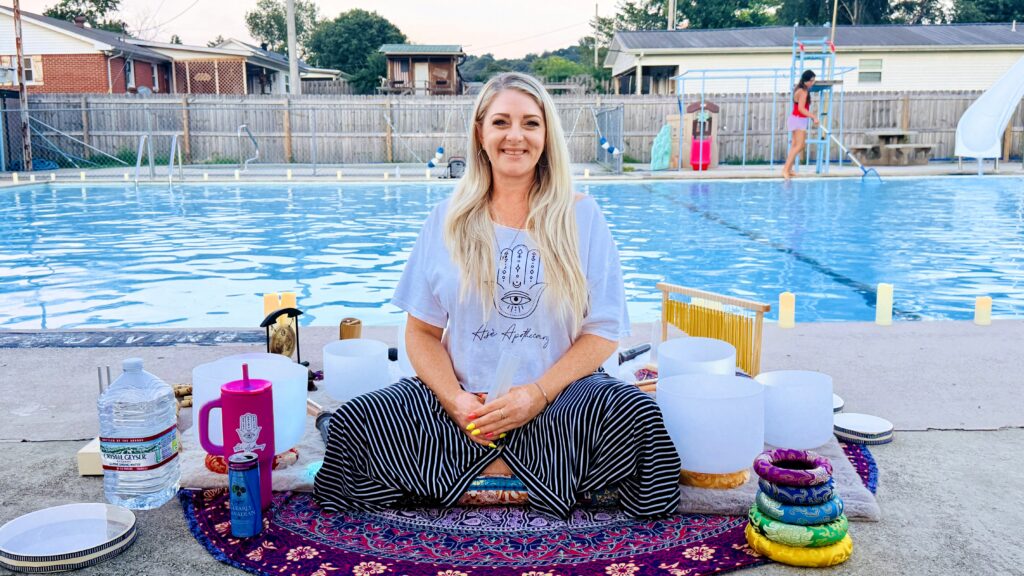
Our host is Nikki Quinlan, a former Lynchburg resident who graduated from Moore County High School in 2004, and who owns Asè Apothecary, a holistic shop in nearby Shelbyville.
She launched her apothecary in 2020 during the height of the COVID 19 pandemic. Looking for answers and feeling uneasy about those she found on the evening news, Quinlan turned to plants, elderberries in particular, for peace of mind.
“I started making elderberry syrup for my family and friends at first. Then I experimented with other items like sea moss, and oil of oregano,” she says.
Word of mouth spread, and as life returned to normal, she expanded from her little cottage industry to local farmer’s markets. Then in 2025, she found a storefront on a corner lot in Bedford County and took a chance on herself with a commitment to a brick-and-mortar shop.
Quinlan’s Floating Sound Bath sells out on the regular in Bedford County — it’s a hard ticket to get. So, when she announced she was bringing the event to Moore County, I jumped at the chance.
THE SCIENCE OF WOO
A few years ago I read “Why Woo Works,” by David R. Hamilton, Ph.D., which lays out the science behind alternative practices like meditation, Reiki and crystal healing. It turns out real evidence backs up more of these ideas than I expected — and it gave my show-me-the-facts journalist brain a bridge into the world of alternative therapies. I’ve since tried plenty of them: red-light sauna, foot detox, meditation, and Reiki. I even drove to Dickson once to have a woman realign my chakras. She lived in a house with too many cats and a dragon sculpture in the front yard. That’s a story for another day.
I’ve documented each of these with a reporter’s mind: immerse first, research later. Some, like red light and Reiki, were genuinely helpful. Others, like the chakra alignment, were more likely the placebo effect at work.
Sound therapy isn’t new, and it isn’t fringe. Researchers at UCLA and elsewhere have spent the last decade studying it in earnest. The practice relies on specific tones, frequencies and vibrations — usually from chimes, gongs, or metal and crystal singing bowls — to promote relaxation or, practitioners say, healing. A sound bath is meant to be a full-body listening experience, one where the vibrations wash over you until you land somewhere between meditation and deep rest.
The clearest, most consistently replicated finding is also the simplest: sound baths reliably produce measurable relaxation. In one widely cited study, 62 participants reported significantly less tension, anger, fatigue and depressed mood immediately after a single Tibetan singing-bowl session. A 2023 study using Tibetan bowls found similar shifts in stress hormones, self-reported anxiety and brainwave activity compared with a control group.
Floating adds a second, separately studied layer. Researchers call it floatation-REST — Reduced Environmental Stimulation Therapy — and it’s been tested specifically for anxiety and depression: participants float supine in water dense with Epsom salt, cutting off most visual, auditory and gravitational input. A meta-analysis of 27 such studies found reliable drops in cortisol and blood pressure. Single-session trials out of the Laureate Institute for Brain Research found anxiety reductions large enough that researchers described the effect size as substantial, with benefits reported to last up to 48 hours after one float.
Clinical floatation-REST, though, is done alone, in silence, in a lightless tank. What Quinlan runs is a hybrid — a shared pool, with sound layered in rather than sensory deprivation. The research behind each piece is real; neither body of research has tested them stacked together quite this way.
Quinlan says the most common feedback she hears is that people sleep better and feel more relaxed for days afterward.
“I have some people that say that it’s better than a massage, that it helps them relax, that they sleep better, and that they feel better the week after, like it carries on into their week,” she says.
INTO THE WATER
On the day of the event, Quinlan greets me warmly with a hug when I arrive — we know each other, since I’m a regular at her Bedford County shop. She hands me off to one of her assistants, whom I later joke are less staff than “sound bath wranglers.” Their real job, it turns out, is corralling all eighteen of us into the shallow end nearest the speakers and Quinlan’s circle of singing bowls. There are also two teenage lifeguards standing by should anyone need them.
Before we begin, Quinlan runs through the basics: put on your sleep mask and relax, grab a blanket if you want one, and raise a hand if you need anything — an assistant will find you. Simple enough.
She explains that the session can be used to release something — a worry, a bad habit, an obsessive thought — or to call in something — a goal, a new pattern, an intention. For anyone with nothing particular on their mind, she says, it can just be a few moments of self-care and deep relaxation.
Ever the reporter, I treat it like an assignment. I silently chant: I surrender and let go of control. I let God support me, and I’m open to receive. Letting go and letting God is a constant struggle for me.
Moments later, Quinlan tells us to take three deep breaths.
“The pool’s got you, just like God’s got you.”
It’s so on-the-nose that I lift the side of my sleep mask to eyeball her. She’s deep in the process and doesn’t notice.
Quinlan had warned us we might see colors, and I do — ocean blue, a swirl of meadow green behind my closed eyes, like the earth is a Magic 8-Ball someone just shook. I stop fighting it and watch the show. It’s strange, and cool.
Floating blindfolded requires its own kind of surrender. I lose track of which end of the pool I’m in, or which direction I’m facing. My brain tries to stay oriented by tracking the sound of the waterfall, until I recognize that for what it is: control, just not-so-cleverly disguised. I let that go too.
Throughout the session, Quinlan moves from singing bowls to chimes to a rain stick — a hollow tube filled with small objects that makes a cascading sound when tilted. The sound arrives in waves, and often I feel the vibration in the water against my body before I hear it in the air. Quinlan had told us this might happen.
“Sound travels faster through the water than the air,” she’d explained before we started.
I didn’t fully understand what she meant until I felt it. It’s a real, well-documented phenomenon: sound moves roughly four times faster through water than through air because water is so much harder to compress, even though it’s far denser.
The tones, the rain stick, the waterfall, the birds — they combine into a one-of-a-kind symphony I eventually melt into. To my surprise, my racing thoughts — the to-do list, the deadlines, the business plan — dissolve into just being in the moment — which, I’m fairly sure, is the point.
For a few minutes, it’s just me, the breeze, the water beneath me, and the waves of sound washing over me.
After about an hour, Quinlan slowly brings us back to reality. We stretch, wiggle our toes, and pull off our sleep masks. Her assistants help each of us out of the pool.
“The healing you received tonight should continue overnight,” she tells us. “You should sleep well, and remember to drink plenty of water.”
After a quick photo for this article, I head home and shower. Reluctant to break the spell, I spend an hour capturing notes for this piece instead of cooking. I’m starving, but too relaxed to bother, so I settle for a peach and a slice of mild cheddar.
Quinlan prediction held. I slept like a rock and woke up surprisingly refreshed. Over the next couple of days, I noticed my foot lifting slightly off the ever-present accelerator in my head. Was it the sound bath? There’s really no way for me to be sure. But it did nudge me into living in the moment for a brief hour on a random Thursday in Lynchburg. That’s not nothing.
NONTRADITIONAL IN A TRADITIONAL PLACE
Days later, I follow up with an interview and ask Quinlan why she thinks the floating sound bath experience has become so popular.
“I think that things in the world right now are tough, and people are hurting. They’re searching for healing and something to calm their nervous systems.”
Introducing new alternative concepts in a very traditional small town can be challenging. When we ask the question directly, Quinlan doesn’t back down from an answer.
“That’s a good one because I get a lot of push back,” she says. “Sometimes it hurts my feelings, because we’re traditionally a Christian area.”
But in the end, Quinlan, who attended Bible college and holds a degree in Christian studies says she understands that people sometimes get frightened by new concepts and ideas, but that there’s room for everyone’s beliefs.
“It’s okay for everybody to have their own beliefs. I don’t have to praise or worship the way that you do,” she says.
If you’re interested in experiencing the floating sound bath for yourself, follow the Asè Apothecary Facebook page. They’ll host a pay-what-you-can sound bath experience on August 8 at the shop located at 701 Whitthorne Street in Shelbyville. Theresa Marie Wilson will also be on hand that day to teach locals about the art of Tai Chi. •
About the Lynchburg Times: The Lynchburg Times is Moore County’s locally owned, independent news source and the only local media source own by a Lynchburg native. Our reporting is supported by readers, small business partners, and underwriters who believe community journalism matters. If this story was valuable to you, consider becoming a supporter at lynchburgtimes.com.