

By Tabitha Evans Moore
Editor & Publisher
LYNCHBURG, Tenn. — If you travel from Lynchburg to Lincoln County often, you’re quietly being tracked.
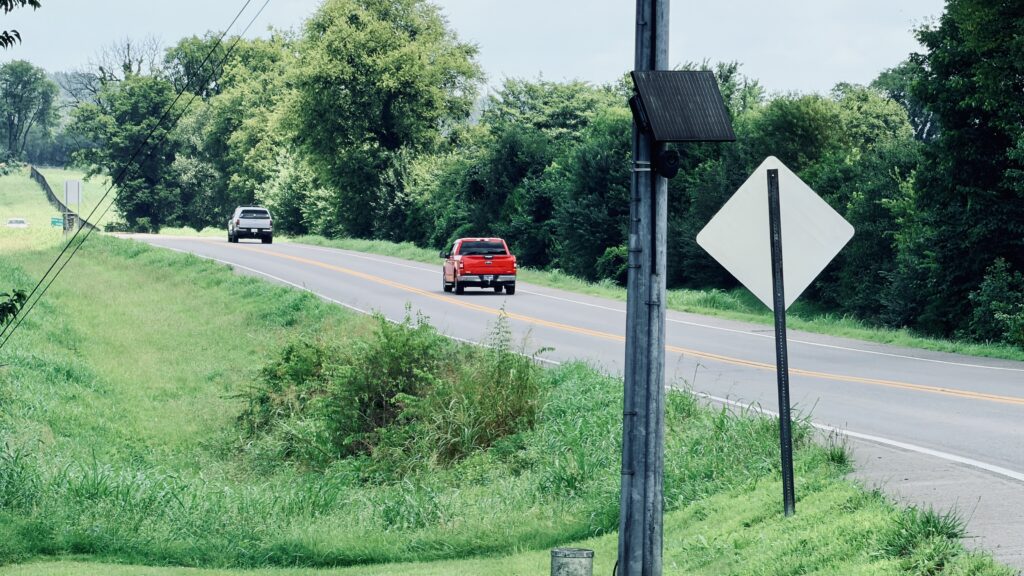
In Mulberry along Highway 50, just three tenths of a mile from the Moore County line sits a small, black oval camera and a rectangular solar panel. As part of the controversial Flock network, each day it tracks every vehicle that comes into view and records the license plate, passengers, make and model, and any “critical” sounds. That data allows thousands of law enforcement agencies across the country to access this expansive database without a warrant.
Some argue they’re a harmless law enforcement tool that allows authorities to work more quickly when precious moments count, like in the case of a child abduction. Others argue that cameras which track license plates can now map your face, your routine and your daily patterns without your knowledge.
And Flock doesn’t provide law enforcement information free of charge. Communities must enter into contracts with Flock to access the data.
Moore County isn’t one of those communities — at least not yet. There are no Flock cameras inside the county, and Sheriff Tyler Hatfield says there are no plans to add any. But the county is nearly surrounded by them.
According to DeFlock, a crowdsourced, publicly editable map of license-plate reader locations, there are four cameras inside the Fayetteville city limits in Lincoln County, eight in Tullahoma and six in Manchester — both in Coffee County — and 18 in Shelbyville in Bedford County. More are mounted along corridors Moore County residents drive regularly: Highway 41A, Highway 64, Highway 231 and a number of rural roads. Winchester, the Franklin County seat, has none listed.
Deflock isn’t fool proof. It currently shows a Flock camera along Main Street near the Lynchburg Square where none exists.
That leaves Moore County sitting in the middle of a loose ring of surveillance infrastructure it has chosen not to join — a choice Hatfield has made deliberately, and one he’s willing to defend on the numbers.
THE SHERIFF’S MATH
Hatfield said Flock has approached Moore County, but he doesn’t believe it’s a tool the county needs — not because he doubts the technology works, but because he doubts it’s worth the cost for how rarely it would be used here.
A single camera runs roughly $2,500 per year. The proposal put in front of Moore County called for 16 cameras, which would carry a yearly line-item cost of about $40,000.
“Too much money for something we’d use a half a dozen times,” Hatfield said. He noted the cameras only return a hit on a specific tag number entered into the system — they don’t flag suspicious behavior or run continuous facial recognition as some claim — which narrows their usefulness to cases where investigators already know what they’re looking for.
There are other costs Hatfield weighs against the technology, too: an increase in the number of pursuits, and the accidents that can come with them, chasing hits that turn out to be dead ends.
Hatfield doesn’t dismiss the value of the cameras outright, though. He pointed to a recent case in a neighboring county: a Moore County woman with dementia who drove away from her home and was later found safe in a hospital parking lot in Tullahoma, in part because of a Flock camera hit there.
It’s the kind of case supporters point to most often — alongside silver alerts and missing-child cases — as the clearest argument for the technology’s value. Hatfield doesn’t dispute that the program has some value. He just doesn’t think it clears the bar of $40,000 a year for Moore County, when the county has other, more frequent needs competing for the same money.
“There many things Moore County needs before it need Flock cameras,” he says.
WHAT THE TECHNOLOGY ACTUALLY DOES
Flock Safety, founded in Atlanta in 2017, has grown into one of the most widely used automated license plate reader systems in the country. The cameras photograph passing vehicles and check plate numbers against law enforcement databases and hot lists, flagging matches to a specific tag rather than monitoring behavior generally.
The company markets the system to a wide range of customers beyond police departments — schools, private businesses, prisons, residential communities, parks and places of worship are all among its client base nationally.
To Flock’s credit, the company has been upfront about the risks of unchecked surveillance and has built in several safeguards against misuse. Every search is recorded in an auditable log, and users are required to record a “public-safety reason” for each inquiry — a structure meant to make misuse traceable after the fact, even if it doesn’t prevent it.
Hatfield sees that accountability structure as a point in the technology’s favor, not a mark against it. When officers or agencies have been caught misusing the system elsewhere and have faced consequences, including losing their jobs, he considers that evidence the checks and balances are doing what they’re supposed to do — not proof the system is broken.
THE PICTURE IN THE REST OF THE STATE
Metro Nashville offers the closest large-scale example of what the technology can do at volume. According to WKRN, Metro Nashville approved a citywide license plate reader ordinance in August 2023 after a six-month pilot program. The Metro Nashville Police Department reported that pilot contributed to 112 arrests and the recovery of 97 stolen vehicles.
Some supporters compare the technology to location-sharing apps like Life360, arguing it’s no more invasive than data people already choose to share. The comparison has a limit, though: sharing your location through an app is voluntary. Driving past a camera mounted on a public road is not.
For now, the closest a Moore County driver gets to a Flock camera is the county line. Every neighboring county town surveyed by The Lynchburg Times — Fayetteville, Tullahoma, Manchester and Shelbyville — has at least one camera in place, with Shelbyville’s 18 the largest concentration in the region. Winchester stands out as the one county seat in the area with none listed.
According to Motlow State’s website, their campuses also utilize ALPR-style readers, however, those readers aren’t connected to a national database. Access to those cameras flows through the Public Safety and Security Director and Assistant Director as well as the Director of Technical Operations. We reached out to the college for confirmation that cameras exist on Moore County’s campus, but representatives could not be reached. To learn more about their Surveillance Camera Footage Access Policy, click here.
Whether Moore County stays “Flock free” is a question Hatfield expects to keep revisiting. Flock has already approached the county once. The math that didn’t work this time — 16 cameras, $40,000 a year, a half dozen meaningful hits — is the same math that will be run again the next time the company, or a neighboring department, or a resident, raises the question. •
About the Lynchburg Times: The Lynchburg Times is Moore County’s locally owned, independent news source and the only local media source own by a Lynchburg native. Our reporting is supported by readers, small business partners, and underwriters who believe community journalism matters. If this story was valuable to you, consider becoming a supporter at lynchburgtimes.com.