

By Tabitha Evans Moore, EDITOR & PUBLISHER
Each May, whiskey lovers around the globe circle May 21 on their calendars as the day to celebrate the moment in 1937 when Tennessee repealed its ban on manufacturing alcoholic beverages – forever changing the lives of folks here in Lynchburg. Thanks to a 2021 Tennessee General Assembly resolution, today is known as International Tennessee Whiskey Day.
But what exactly is Tennessee whiskey? How is it different from other whiskeys and bourbons on the market? What is the Lincoln County Process and where did it come from?
This year, we decided to celebrate May 21 by taking a deep dive into the origins of the charcoal mellowing process that distinguishes our local product from other whiskey through the lens of history using both Jack Daniel’s Historian Nelson Eddy and Ben A. Green’s biography Jack Daniel’s Legacy as our main sources. But first, a little local and state history.
The repeal of Prohibition in Tennessee
Tennessee exists today as a deeply conservative state and things weren’t much different back in the early 1900s. Tennessee ratified the 18th Amendment, otherwise known as National Prohibition on January 13, 1919, along with most of the country. The new amendment went into effect nearly a year later and would not be repealed until December 5, 1933, with the passing of the 21st Amendment to the U.S. Constitution.
That amendment handed control of alcohol back to the state and our state decided to make all 95 Tennessee counties dry by default. However, it also handed that decision back over to individual counties by allowing a county to become “wet” by passing a county-wide “local option” referendum. Moore County has yet to pass such a referendum, which is why it’s one of nine Tennessee counties to remain dry to this day.
It’s only through a set of loopholes and one-off resolutions and amendments that anyone in Lynchburg enjoys a drop of whiskey for a price, but that’s the subject of a whole separate article.
Enter The Lincoln County Process
In 2021, then Governor Bill Haslam’s International Tennessee Whiskey Day resolution defined a Tennessee Whiskey as “being made from fermented mash of at least 51 percent corn, aged in new oak barrels, charcoal mellowed, and produced in the state of Tennessee.”
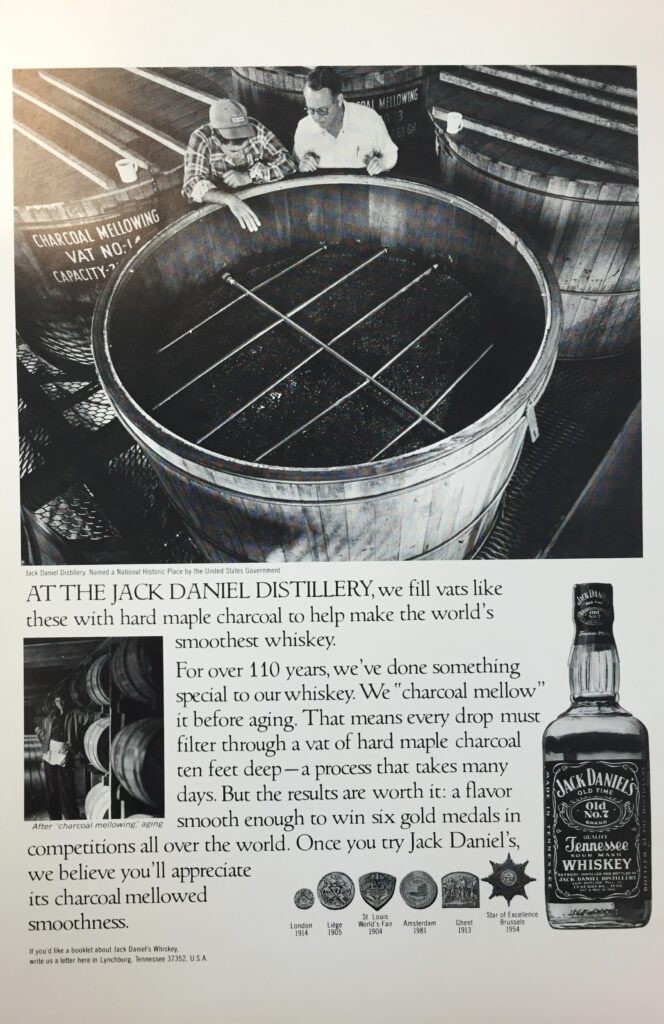
It’s the “charcoal mellowed” piece otherwise known as The Lincoln County Process that really sets Jack Daniel’s and other Tennessee whiskeys apart. Because the distillery discusses the Process in much of its marketing literature, there’s a common misconception that Jack Daniel invented it – something distillery historian Nelson Eddy says couldn’t be farther from the truth.
“The Lincoln County Process existed in this area long before Jack Daniel was born,” Eddy says. “There’s certainly evidence that the Alfred Eaton Distillery – which predates The Jack Daniel Distillery – used The Lincoln County Process in the early 1800s. He likely got the idea from some enslaved people.”
Eddy says the idea of using charcoal as a filter goes all the way back to Egypt.
“It’s an ancient filter. People have always known you could use charcoal as a filtration process for water and other substances. Its existence predates whiskey being made in Tennessee even.”
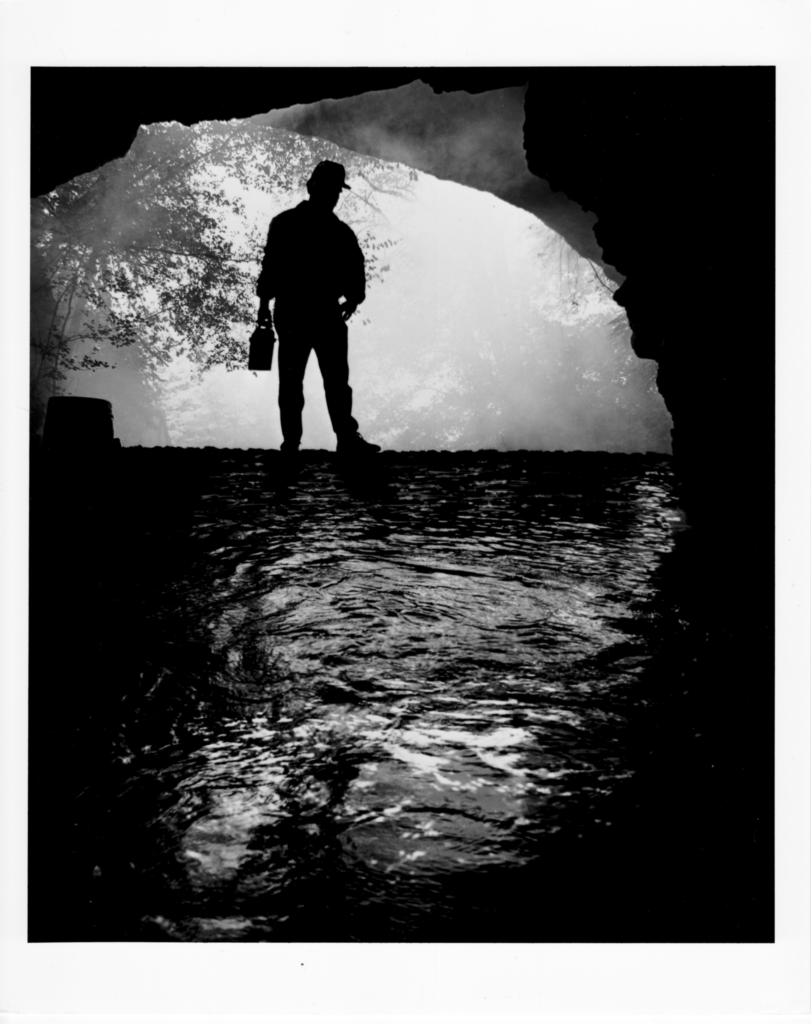
Eddy also points out that Jack Daniel did not purchase the cave spring here in Lynchburg until 1884 and multiple distilleries including the Alfred Eaton Distillery used that same water to produce whiskey. In fact, according to the Green biography, Jack’s new distillery in Lynchburg near the cave spring sat on the “very place where Alfred Eaton had established what was believed to be the first whiskey still in the area that became Moore County.”
According to the Green biography, Jack chose the location not only for the water but also due to his need to get closer to mass transportation like the rail lines that had moved to Tullahoma just before the Civil War.
“It was an interesting set up,” Eddy says. “There was a church located right there beside the distilleries. That’s why the Bethel House has a graveyard behind it. That was once The Bethel Baptist Church.”
Eddy says Jack Daniel didn’t discover the Lynchburg Cave Spring and he didn’t invent The Lincoln County Process, but he did use them both to improve the quality of whiskey produced here in Lynchburg. Some whiskey historians claim that early users of the process, like Eaton, used only a single foot of charcoal to filter whiskey. Daniel’s Old No. 7 gets filtered through 10 feet for comparison.
By the late 1890s, the Jack Daniel Distillery is credited in a local newspaper story for changing its charcoal out more often. This likely led to Old No.7 receiving seven gold medals in 1904 World’s Fair in St. Louis, Missouri and forever cementing it into the lore of the brand.
“I like to say Jack was more like Steve Jobs than Thomas Edison. He didn’t invent anything. Thomas Edison invented things. Steve Jobs brought great things together in a cool package. He made it all work together. And that’s what Jack did.”
The Lincoln in The Lincoln County Process
So why does a Lynchburg distillery located in Moore County, Tennessee pride itself on using something called The Lincoln County Process? Because whiskey in this part of southern, middle Tennessee predates the establishment of Moore County in 1871.
The Dan Call Farm, where Nearest Green taught Jack Daniel to make whiskey, existed on Louse Creek Road in the Lois Community – part of Lincoln County at the time. According to Ben A. Green’s biography of Jack Daniel, Call inherited several hundred acres from relatives, and his tract “was split in the middle by Louse Creek.” At the time, Call would have been one of the larger property owners in the county.
Founders established the county via state resolution by annexing parts of Lincoln, Bedford, and Franklin counties. At one point, it measured nearly 300 square miles but interestingly, Lincoln County sued and successfully reclaimed a portion of its land, reducing the new county’s size to around 130 square miles. By 1875, The Jack Daniel Distillery would have been one of around 15 operating in the area.
Eddy sees this as even more proof that The Lincoln County Process existed long before Jack Daniel made whiskey and even before Nearest Green, as some records show his birth year as being around 1820, and according to oral tradition the Alfred Eaton Distillery was already mellowing whiskey through charcoal when Nearest was a small child. Even after Jack moved into The Holler in Lynchburg, other local distilleries like “Hiles and Berry, and Jack Eaton in the firm Tolley and Eaton” continued to use the cave spring,” according to Green.
Jack and Nearest’s original still existed on that Louse Creek property and Green’s book refers to Daniel as one of “the youngest whiskey still owners in the business” and to Nearest as his “head distiller.” After he relocated to Lynchburg, Nearest stayed behind on the Call Farm. His sons, Eli and George, went with Jack and helped him meet his goal of producing 75 gallons a day, using The Lincoln County Process, according to Green.
Intersection of opportunity and tradition
In Lynchburg, the charcoal making process is as much fun as the charcoal mellowing. Each piece used for whiskey filtration is made right here in Lynchburg and that process remains identical to the first batch.
They no longer use staves milled on site, but three days a week, a couple of local employees stack pallets of hard sugar maple around five feet high, saturate them in raw unaged whiskey, and then start a big ole bonfire. It’s allowed to burn to around 2,000 degrees Fahrenheit before it’s put out – resulting in a pile of smoldering embers otherwise known as charcoal. It used to be produced in an open-air fire, but local officials added a hood for environmental reasons.
“It’s got an afterburner so any smoke, coming off that that still contains particulates goes through a second burn, and cleans it up,” Eddy says.
After it’s used for filtration, most of the charcoal gets resold to consumers for grilling purposes.
In the end, The Lincoln County Process likely emerged at the intersection of opportunity and tradition. The Old No. 7 grain bill remains the same as it did when Jack and Nearest made it: 80 percent corn, 12 percent barley, and eight percent rye. Eddy says the prevalence of corn in the mashbill stems from the fact that it’s a readily available grain in southern, middle Tennessee.
“Malted barley and rye would have been in shorter supply and harder to grow maybe in this climate,” he says. “In Ireland they use more malt because of the climate. Here, it tends to be corn. People use what’s readily available.”
Combine a corn-dominated spirit with a tradition handed down from the southern slave culture and together you arrive at a Tennessee Whiskey. Like most iconic American ideas, it’s a blending of an old practice with an entrepreneurial twist.
After he relocated, Jack heard rumblings that “the federal government was moving in” to collect taxes. Ever one to handle a problem head on, Jack met with the “Government Man” immediately, according to Green and officially filed registration as Jack Daniel Distillery in 1866 – making it the oldest registered distillery in the United States.
And that’s the story of how an ancient tradition, met with go-getter attitude in a magical spot with iron-free water that flowed at 56 degrees year round to create a little hometown product we like to call Old. No. 7 – a Tennessee Whiskey enjoyed around the globe.•
{The Lynchburg Times is the only locally owned and locally operated community newspaper in Lynchburg, Tennessee. We offer common-sense, fact-driven local stories written by a Lynchburg native with over 20 years of journalism experience. Click here to subscribe.}