

By Tabitha Evans Moore
Editor & Publisher
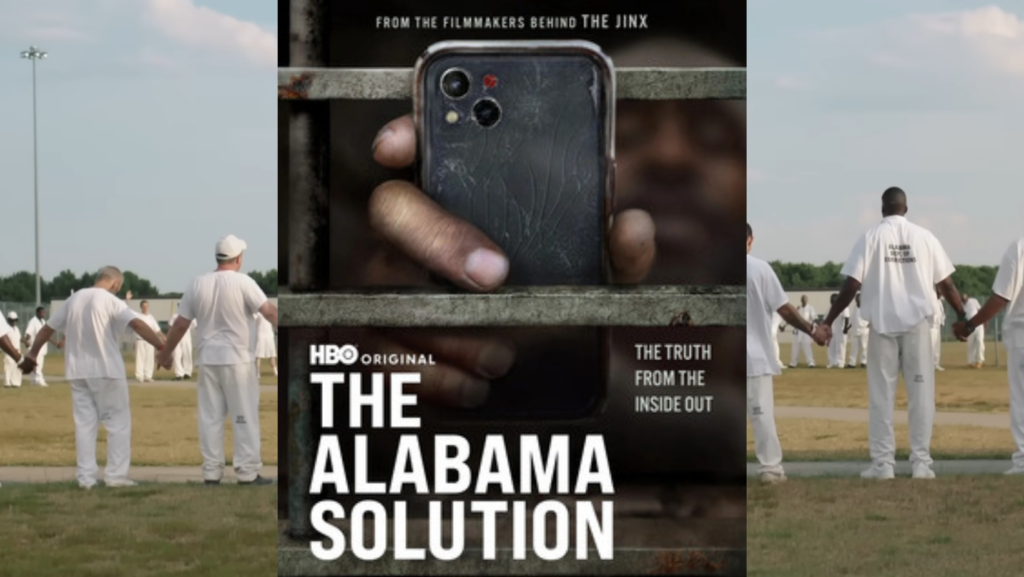
There’s a moment early in The Alabama Solution — the Oscar-nominated documentary up for Best Documentary Feature this Sunday — when the camera shakes. It’s not a stylistic choice. It’s a man filming from inside a prison dorm on a contraband cell phone, trying not to be caught. What he’s recording is something Alabama’s Department of Corrections spent years trying to prevent anyone from seeing: the inside of one of the deadliest prison systems in America.
That shaky, forbidden footage is the beating heart of a film that has rattled Alabama’s political establishment, moved audiences at Sundance, and landed at the center of a national conversation about what happens when institutions decide the truth is their enemy. Directed by Andrew Jarecki and Charlotte Kaufman — the team behind The Jinx — The Alabama Solution is more than a prison documentary. It is a story about corruption, untethered power, and the extraordinary lengths ordinary people will go to when the press is locked out and the official narrative is a lie.
When the State Becomes the Story
The film’s origins are almost parable-like. In 2019, Jarecki and Kaufman visited Easterling Correctional Facility in Barbour County to document a religious revival meeting — one of the rare, controlled moments when outsiders were allowed inside. Between the hymns and the sermons, incarcerated men approached them off-camera and whispered what was really happening. That was the beginning of a six-year investigation.
Because professional crews were subsequently denied access, the filmmakers pivoted. They built a network of trust with men inside multiple facilities, who used contraband phones to document their world — overcrowded dorms, sewage leaks, rampant violence, and what the film characterizes as forced labor. At the center of the story is the 2019 death of Steven Davis, beaten to death by prison guards at William E. Donaldson Correctional Facility in Bessemer. His mother, Sandy Ray, becomes one of the documentary’s moral anchors as she seeks answers that no official is willing to give her.
The film also profiles Robert Earl Council (known as “Kinetik Justice”) and Melvin Ray, co-founders of the Free Alabama Movement, who organized labor strikes from inside prison and paid for it dearly. After the documentary gained traction, both men — along with a third activist — were transferred into solitary confinement. The message from the state was unmistakable: speak up, and you will be buried deeper.
The Title Tells You Everything
The film’s title comes directly from Governor Kay Ivey, who has long insisted that Alabama can solve its prison crisis on its own terms — without federal intervention, without outside scrutiny, and, it would seem, without the press. Her solution: build bigger prisons. Following the Oscar nomination, Ivey issued a public statement defending her record, calling herself one of the most respected prison reform leaders in the country.
The documentary begs to differ. Between 2019-24, more than 1,300 people died in Alabama’s custody. Those are not statistics the state has been eager to publicize. Former corrections officer Stacy George, who appears in the film, describes an institutional culture of neglect and abuse — food unfit for consumption, beatings that go uninvestigated, silence enforced from the top down. “It’s gratifying to see the truth coming out that was hidden for so long,” says Beth Shelburne, the former television anchor and investigative reporter who co-produced the film after years of covering Alabama’s prisons.
A New South Reckoning
Southerners of a certain generation have grown up with two competing narratives about the region. The first is the Old South myth — the moonlight-and-magnolias story, or its darker shadow, the one that justified what it should not have. The second is the New South promise: a region evolved, a place of economic growth, racial progress, and a matured political culture. The Alabama Solution complicates both.
What the film exposes is not a relic of the past. The prison system it documents operates under laws shaped by the 13th Amendment’s punishment exception, which permits involuntary servitude for the convicted — a loophole that critics argue has allowed a form of state-sanctioned forced labor to persist well into the 21st century. As one of the film’s voices puts it plainly: “This is not a Black problem. This is an American problem.” But in Alabama, the racial dimensions of who is incarcerated and who wields power over them are impossible to ignore.
The New South has always been more complicated than its boosters admit. Economic transformation does not automatically mean institutional accountability. Gleaming skylines in Birmingham and Huntsville coexist with a corrections system that, by the documentary’s account, operates with the opacity and impunity of something that fears the light. The Alabama Solution is, among other things, a reminder that modernity in the South — as everywhere — is uneven, and that the people most harmed by its gaps are the people with the least power to demand otherwise.
What the Press Was Never Supposed to See
There is a media story embedded in this film that deserves its own reckoning. Alabama journalists have long documented the restricted access to state prisons — a deliberate policy of information control that the filmmakers argue has allowed dangerous conditions to fester unchecked. The Alabama Solution exists precisely because the system tried to prevent it from existing. The contraband phones, the whispered testimony, the six years of methodical trust-building — all of it was necessitated by a state that decided accountability journalism was a threat to be managed.
That context matters enormously right now, when the relationship between institutional power and a free press is under sustained pressure across the country. The Alabama Solution is not just a documentary about prisons. It is a case study in what happens when official channels are closed — and what it costs the people inside when the cameras are kept out. The men who filmed on contraband phones knew the risk. Some are still paying it.
The Oscar Nomination Is Not the End
Last Tuesday night, community members, activists, and local leaders filled Birmingham’s historic Carver Theatre to watch the film together. Birmingham City Councilor LaTonya Tate, whose son is formerly incarcerated and who spent years as a probation officer, said the issue extends far beyond any documentary.
“When people are released from prison,” she said, “a lot of people come to Jefferson County — and they’re coming out with nowhere to stay.”
The film is a beginning, not a conclusion.
The men who spoke on camera — who trusted filmmakers with footage that could get them killed, who organized and advocated and refused to be silent — are not waiting for Hollywood to validate their reality. Winning an Oscar would bring attention. But as incarcerated writers from Donaldson Correctional Facility wrote in their own account of the film’s nomination, the fear is that once the excitement fades, it will be “back to business as usual in Alabama.”
Director Kaufman has said she hopes audiences see the film as “an urgent call to reconsider how we approach these things.” She’s also said something that should stay with every Southerner who watches it: “The Alabama solution in Alabama could become — in many cases, it already is — the American solution.” •
About The Lynchburg Times: In addition to local news, The Lynchburg Times covers Southern culture, community life, and the stories of the New South — as part of its commitment to journalism that is local by choice and independent by design. This work is supported by readers, small business partners, and corporate underwriters.