

By Tabitha Evans Moore
Editor & Publisher
LYNCHBURG, Tenn. — Local farmer Scott Fruehauf comes from a long line of innovators, and there’s a family thread running through his willingness to go first. His grandfather flew the SR-71 Blackbird, one of the first strategic reconnaissance aircraft, and worked at Area 51. His great-grandfather competed in the 1936 Olympics as part of the U.S. rowing team.
So, when Lynchburg Renewable Fuels approached him about being the guinea pig for their new fertilizer product, he thought, “why not.”
Along Motlow Barns Road, which parallels Highway 55 through the heart of Lynchburg, sit two hay fields side by side. The field on the right belongs to the Bedford family. The one on the left belongs to Fruehauf — and this spring, it became the testing ground for one of the first batches of digestate fertilizer ever produced by Lynchburg Renewable Fuels — the 3 Rivers Energy Partners anaerobic digester that turns spent distiller grain from Jack Daniel’s Distillery into biogas and fertilizer.
The project started over four years ago, and not without controversy.
FROM SLOP TO BIOGAS: HOW WE GOT HERE
In 2022, the American whiskey industry was booming. Folks at the distillery were looking to double or even triple production over the coming years — but they had a problem. Every day the distillery makes whiskey, it also produces around 400,000 gallons of spent distiller grain, known colloquially around Lynchburg as slop. At the time, local farms hauled much of it off to feed cattle, a generations-old arrangement that suited both sides.
But more production meant even more spent distiller grains, and with Moore County already bursting with cattle feed lots all that additional slop needed to go somewhere. Enter the idea of an anaerobic digester to convert the slop in to natural gas and fertilizer.
At first, Jack Daniel’s sought to phase out the Cow Feeder program entirely, but pushback from local farmers — many of whom also work at the distillery — forced a compromise. The plan became to convert an estimated 200 million gallons of slop per year into natural gas and fertilizer through anaerobic digestion, while selling the remainder as low-cost feed.
Then the whiskey market turned.
In 2023, when the digester broke ground, the U.S. whiskey industry posted its first volume decline in over 20 years — dipping one percent, according to the Spirits Business. American whiskey volumes dropped another two percent the following year, and domestic U.S. spirits sales fell 2.2 percent in 2025, doubling the rate of decline from the year before, according to the Distilled Spirits Council. On the export side, American whiskey exports fell 19 percent in 2025 — a $250 million loss — as EU tariff uncertainty choked off the overseas market.
Less production means less slop. And by March 2026, caught between a 3 Rivers contract and a hard place, the distillery made a tough call: it phased out the Cow Feeder program completely.
Though he never hauled slop himself, Fruehauf is empathetic to how some local folks feel about the change.
“That’s not what we all wanted. We all wanted to keep doing what everybody’s been doing for the last sixty years. But whenever that’s off the table, you’ve got to figure out what you’re going to do next.”
“SOMEBODY’S GOT TO BE THE TEST DUMMY.”
Fruehauf came to the experiment through his day job. As a general superintendent at Lee Adcock Construction, a Bedford County commercial construction company, he worked on rebuilding the digester tanks on-site at Lynchburg Renewable Fuels after the originals failed during a pressure test in September 2024, spilling 2.2 million gallons of lake water across Good Branch Road. In the course of that work, he got to know the 3 Rivers team.
“Whenever I was talking to them, they asked if I knew anybody that had any property near the high school with some hay fields that would be easy for everybody to see — for them to do their initial test on,” he says. “I happen to have one of those fields.”
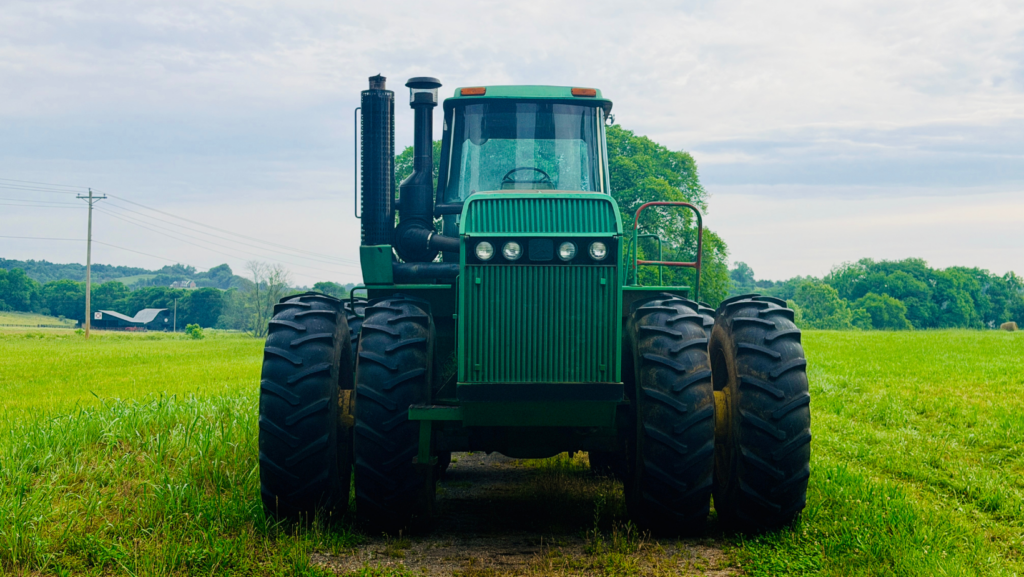
The field sits at the corner of Motlow Barns Road and Highway 55, visible to anyone passing by. It’s about six and a half acres. The plan calls for applying approximately 15,000 gallons of digestate per acre over three passes, loaded from a frac tank at Motlow Barns using a 4,000-gallon John Deere slurry wagon. The digestate — what remains after organic material breaks down in the anaerobic digester — is rated at a 25-10-10 nutrient profile: nitrogen, phosphorus, and potassium.
For reference, most commercial hay fertilizers run closer to 60-40-60 formulation, according to Fruehauf. The lower concentration is part of why the application volume is so high.
“That’s why the spread rate is so high. They think a field can take that much volume at 15,000 gallons an acre, and they think it can handle much more than that. But we’re going to start slow and work our way up.”
Fruehauf is paying nothing for the product or the application — this first run is a mutual trial, not a commercial transaction. He’s fully aware of what that means.
“Somebody’s got to be the test dummy,” he says.
TWO FIELDS, ONE ANSWER
The experiment has a built-in control. Directly adjacent to Fruehauf’s test field, on the other side of an old road that marks the property line, sits a Bedford family hay field that was fertilized the conventional way — by the co-op, in the spring, at standard rates. Fruehauf’s field will be compared directly against it.
“The hay field to the right of that old road got fertilized by the co-op in the spring. And if my field on the left looks as good or better, I’d say it’s a success. If everything in that field dies next week, that’s probably a failure,” he jokes.
But he says the simplest measure of success will be visible from the road.
“The quickest and easiest way to know whether or not it worked is to drive out there and look at it. If one side’s greener than the other, one side’s thicker than the other, you know something’s working.”
THE MATH BEHIND THE EXPERIMENT
For local farmers, the stakes are more than curiosity. Fertilizer costs have climbed steadily in recent years — Fruehauf says he was paying around $95 per acre this season on his other fields, up from roughly $90 the year before, even after pre-buying in January to beat price volatility tied to Middle East tensions. That’s before factoring in a broader national picture: anhydrous ammonia — the most direct nitrogen fertilizer, and the one most tightly linked to natural gas prices — is currently trading around $1,118 per ton nationally, according to DTN.
If digestate can substitute for even part of that, the numbers start to move. And Fruehauf sees an application beyond fertilizer value alone.
This spring’s drought hit Moore County hard. Fruehauf says hay yields on his wheat fields dropped 65 percent year over year on the same inputs.
“I got 109 bales last year. I got 38 bales this year so far. Same inputs, different yields,” he says.
His cost per bale climbed from the mid-fifties to close to $150 as a result. And that’s where he sees the real long-term potential of the digestate program — not just as fertilizer, but as water.
“Hay yields are down sixty percent. If we could have been applying a souped-up water back in March, we would have got the yields, and that would have brought our cost per bale back down from north of one hundred to back down in the fifties.”
In other words, at higher application volumes, digestate could function as a form of supplemental irrigation — carrying moisture and nutrients simultaneously. It’s a use case that doesn’t require the product to replace conventional fertilizer outright; it just needs to be cheap enough to apply at scale.
“If I can grow more grass, I can have more cows. The more cows I have, the more revenue I have.”
THE NEED FOR OTHER LOCAL FARMERS
The volume of digestate Lynchburg Renewable Fuels needs to distribute is too large for any one farmer to absorb. Fruehauf says that’s actually part of what makes local distribution important.
“The volume they have to get rid of is too much for any one person to take. They can’t send it all to the row croppers out in Franklin County. They need to get rid of some of it locally, and the more they can get rid of locally, I think the better off everybody is,” Fruehauf says.
Another early adopter is Daniel Gray, a Moore County farmer who grows corn for the distillery and is currently testing the digestate on hay fields near the Hurdlow Bridge, with plans to apply it to corn during the next planting season. Gray says the idea isn’t entirely new to him — he saw what the liquid slop could do on his fields before the digester came online.
“There are times that we applied it to our fields and saw a big advantage to it when it was still just slop,” Gray says. “If it works as well now as it did then, I wanted to put it on a larger scale and see if we could make it work for us — possibly with fertilizer being so high this year, cut down on fertilizer costs in later years.”
Both Fruehauf and Gray acknowledge that not everyone in Moore County is enthusiastic about the direction things have gone. The Cow Feeder program had deep roots. But both say they are farmers and businessmen with an eye toward cutting costs wherever possible — and neither is inclined to dwell on what’s been lost.
“Being able to save on fertilizer — especially if it was cheap enough that you could put it on pasture — could still be a really good thing and still give a competitive edge to a cattle farmer in Lynchburg,” Fruehauf says.
A SINCERE DESIRE TO HELP LOCAL FARMERS
One thing bleeds through when you speak to Marshall Miller, the man in charge of land application at Lynchburg Renewable Fuels: sincerity.
Miller says they’ve distributed close to one million gallons of digestate since the plant began full operation in March and April of this year, and he says the reach is wider than just Fruehauf and Gray. For example, Gray is applying the product not just on his own fields, but as a custom applicator for other Moore County farmers whose names Miller doesn’t always know in advance.
“He’ll just say, hey, I am at such and such place today,” Miller says. “That’s where we’re land applying.”
Miller also seems to genuinely want to help. The program is free for now. Miller is covering the cost of trucking and application equipment himself. He’s honest that it may not stay that way forever, but says his priority right now is proof of concept, not revenue.
“I don’t want the farmers to have to incur the cost of buying the equipment to do all that, and I want to prove to them that it works,” he says. “After a two-year program, whatever it may be, it’s still going to be at half nutrient value cost to them. But I just want to help them mold their program.”
Early results in Kentucky, where 3 Rivers started applying in February and March, have been encouraging enough that a waiting list is forming for fall application on hay fields and pasture there.
Miller says the initial bristly reception from some in the Moore County farming community has started to soften — and he thinks the transition away from the Cow Feeder program may actually be part of why.
“I think since the program has stopped and some people have gone to a different program and starting to realize that maybe that wasn’t the best feeding method — I think it can help them even more,” he says. “But I need somebody to open that door.”
He’s asking local farmers to be that door. Moore County farmers interested in participating in the digestate land application program can reach out to Miller at 269-528-8486.
“The more that I get, the better. I think this would be a great thing for them and us,” he says.•
About the Lynchburg Times: The Lynchburg Times is Moore County’s locally owned, independent news source and the only Lynchburg media source owned by a Lynchburg native. We are also one of the few women-owned media organizations in the state. Our reporting is supported by readers, small business partners, and underwriters who believe community journalism matters. If this story was valuable to you, consider becoming a supporter at lynchburgtimes.com.