

By Tabitha Evans Moore
Editor & Publisher
NASHVILLE, Tenn. — Moore County could soon find itself with a new voice in Washington if Tennessee Republicans succeed in redrawing the state’s congressional map during an ongoing special session at the Capitol.
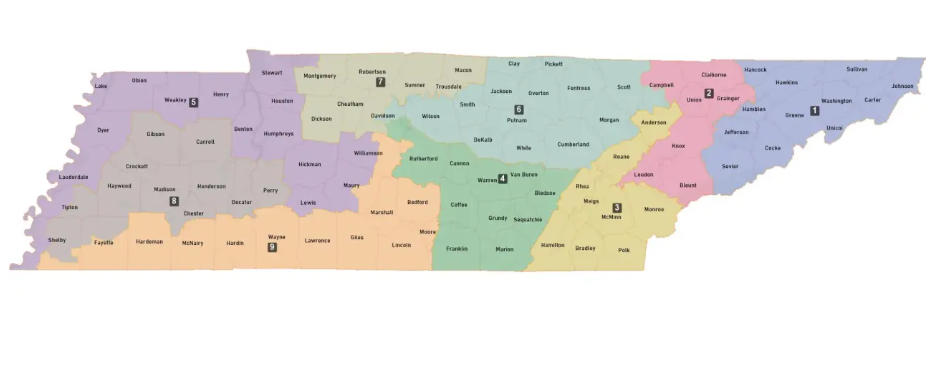
Under a proposed map released Wednesday by House Speaker Cameron Sexton and Senate Majority Leader Jack Johnson, Moore County would shift from the 4th Congressional District — currently represented by Rep. Scott DesJarlais — into the new 9th Congressional District, a sprawling seat that would stretch from near Memphis along the entire southern border of the state into Middle Tennessee.
The proposed 9th District would pair Moore County with it’s neighbors in Bedford, Lincoln, Marshall, Giles and Lawrence counties as well as parts of Rutherford, Williamson and Maury counties. It would then run east to west along Tennessee’s southern boundary to include Wayne, Hardin, McNairy, Hardeman, as well as parts of Fayette and Shelby counties — extending into near the Memphis metro area. The new district would be among the longest in the state geographically, connecting communities in Middle Tennessee on the east end with Memphis on the west — roughly 300 miles apart.
The map is contained in HB 7003, filed by Speaker Sexton, with Senate companion SB 7003 carried by Johnson. Gov. Bill Lee called the special session May 1 following a U.S. Supreme Court ruling in Louisiana v. Callais that struck down racial redistricting protections under the Voting Rights Act. Republicans framed the session as an effort to align Tennessee’s congressional delegation with the state’s conservative voter majority.
“Tennessee is a conservative state and our congressional delegation should reflect that,” Sen. Jon Stevens, R-Huntingdon, said in a statement.
The broader fight driving the session centers on Tennessee’s current 9th District — the state’s only Democrat-held congressional seat — represented by Rep. Steve Cohen of Memphis. The proposed map would fracture Memphis into three separate congressional districts, drawing national criticism for eliminating the state’s only majority-minority district. Democrats and civil rights advocates have called the plan a targeted effort to dilute Black voting power in one of the nation’s largest majority-Black cities.
For Moore County residents, the more immediate question is what representation under a district tied to Memphis would look like. The county’s approximately 6,000 residents would share a congressman with communities hundreds of miles away with vastly different economic and civic priorities.
For example, rural Moore County would be the smallest population of the nine counties in the new District 9 and share worldviews with similar small towns in Lincoln, Lawrence, Giles, Franklin counties but likely hold vastly different view and priorities from suburban Fayette County and parts of urban Shelby County.
Under the current map, Moore County has been part of the 4th District, which covers much of Middle Tennessee’s southern tier including Murfreesboro and Lynchburg. DesJarlais has represented the district since 2011.
As of Thursday morning, HB 7003 and its companion bills were on both the House and Senate floor calendars for final votes, with Republican leadership expecting to close out the session by end of day. The full package passed committee in both chambers Wednesday on party-line votes, after senators were briefly forced to relocate to a different room when dozens of protesters filled the Senate chamber.
More than $3 million has been appropriated to reimburse local election offices for costs incurred by the redistricting. Legal challenges are expected to follow quickly — Democrats have argued that in 2022 the Tennessee Supreme Court blocked a redistricting effort as too close to an election, and they are counting on the courts to intervene again.
Democrats in the legislature have called the session an unconstitutional mid-decade gerrymander, and national redistricting groups have already signaled opposition. Under state law, redistricting is typically prohibited outside the once-per-decade cycle following the census — a restriction Republicans moved to suspend as part of the same legislative package.
If the map is signed by Gov. Lee, it would take effect ahead of the Aug. 6 primary, though whether courts allow that to stand remains an open question. •
About the Lynchburg Times: The Lynchburg Times is Moore County’s locally owned, independent news source. Our reporting is supported by readers, small business partners, and underwriters who believe community journalism matters. If this story was valuable to you, consider becoming a supporter at lynchburgtimes.com.