

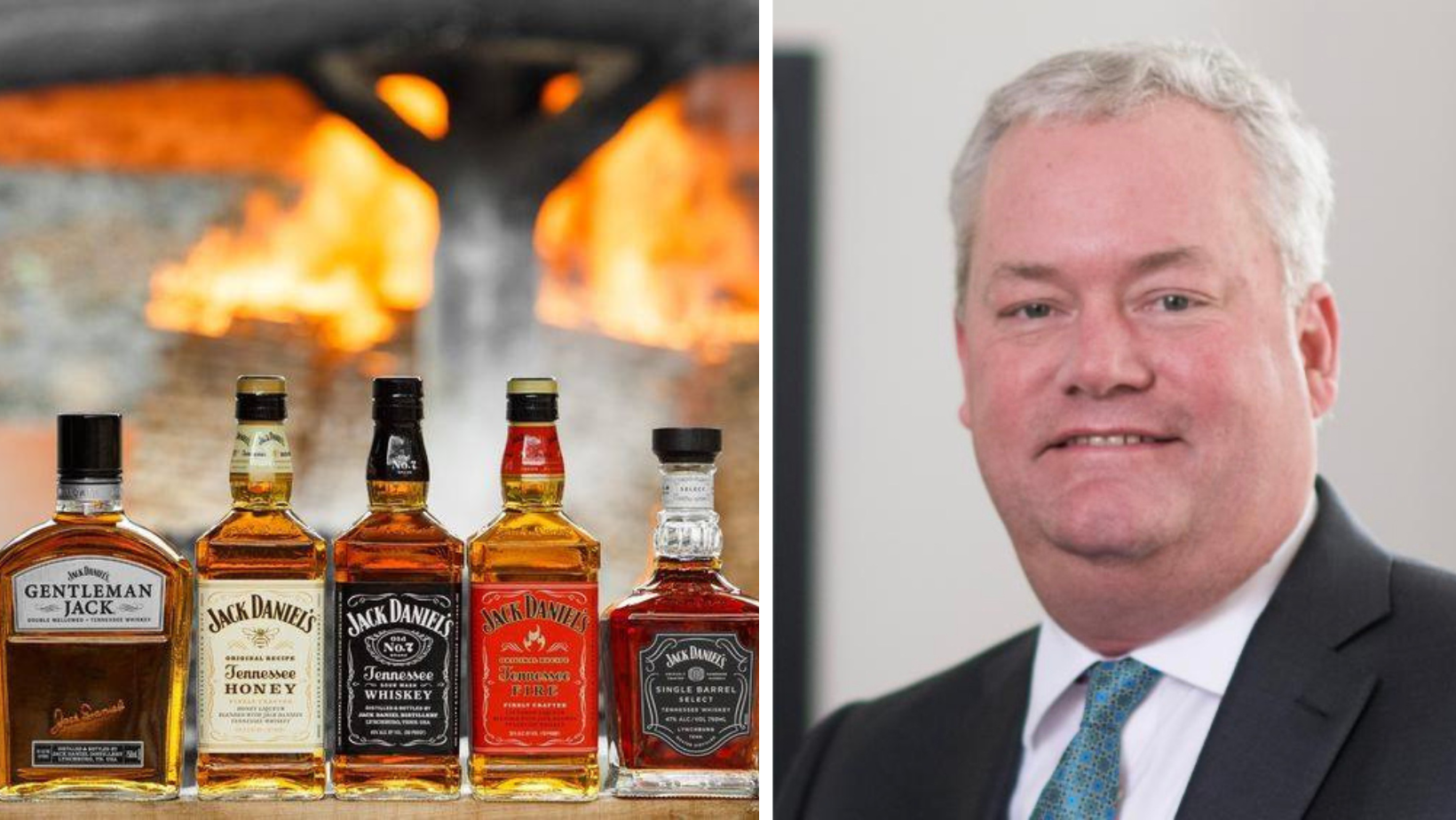
LYNCHBURG, Tenn. — The chief executive of the company that owns Jack Daniel’s is stepping down.
Brown-Forman Corporation announced Monday that President and CEO Lawson Whiting will retire once the company’s board of directors names a successor. Whiting, a nearly 30-year veteran of the Louisville-based spirits company, will stay on in an advisory role after a new chief executive is appointed to ensure what the company called “a smooth handover.”
The announcement matters here more than almost anywhere else. Brown-Forman is the parent company of the Jack Daniel Distillery, the economic anchor of Moore County and the reason Lynchburg appears on back bar shelves in more than 170 countries.
The board’s search will consider candidates from both inside and outside the company, and will be led by the Corporate Governance and Nominating Committee, chaired by director Tracy Skeans.
RETIREMENT AFTER A ROUGH PATCH
Whiting’s exit caps one of the most turbulent years in Brown-Forman’s modern history — a stretch The Lynchburg Times has covered closely because every twist carried implications for the distillery down the road.
In late March, Brown-Forman confirmed it was in merger talks with French spirits giant Pernod Ricard, the maker of Jameson Irish whiskey and Absolut vodka, in what both companies described as a potential “merger of equals.” Those talks collapsed on April 28, with both sides saying they could not reach mutually agreeable terms.
While the Pernod talks were still alive, privately held Sazerac — the maker of Buffalo Trace bourbon and Fireball Cinnamon Whisky — came forward with a takeover offer of its own, reported at roughly $15 billion, or $32 per share. In mid-May, the Wall Street Journal reported that Brown-Forman’s advisers told Sazerac the company was not interested. Neither company has publicly confirmed the rejection.
Behind the deal drama is a simple problem: people are drinking less. Brown-Forman’s fiscal 2026 results, released June 4, showed full-year net sales down 1 percent to $3.9 billion and operating income down 10 percent to $1 billion. The company blamed “macroeconomic pressures and geopolitical instability” that it says continue to weigh on consumer behavior and alcohol consumption, especially in developed markets like the United States. The slowdown is industry-wide — it is the same downturn that pushed Brown-Forman and Pernod Ricard to the negotiating table in the first place.
SALES OF JACK REMAIN FLAT
Monday’s announcement included one sentence of corporate shorthand worth translating: the company “reiterated its fiscal 2027 outlook as disclosed on June 4, 2026.”
In plain terms, that outlook is not rosy — but it is stable. On June 4, Brown-Forman told investors it expects sales in the current fiscal year to be roughly flat, with operating income declining 3 to 5 percent. Repeating that guidance on the same day it announced the CEO’s retirement is a deliberate signal to Wall Street: the leadership change does not change the financial forecast.
There is a Lynchburg detail buried in that June guidance. Among the reasons Brown-Forman gave for its confidence in fiscal 2027 was the continued expansion of Jack Daniel’s Tennessee Blackberry, the flavored whiskey launched last year that the company says exceeded expectations. Whatever happens in the Louisville boardroom, the growth plan still runs through what gets made here.
A FAMILY THAT STILL HOLDS THE KEYS
For all the merger speculation of the past year, one fact has not moved: the Brown family decides.
George Garvin Brown founded the company in 1870 with Old Forester bourbon — the first bourbon sold in sealed glass bottles. More than 155 years later, his descendants still control a majority of Brown-Forman’s voting power, according to the company’s most recent proxy filing with the Securities and Exchange Commission. That means the family can ultimately approve or reject any merger, sale, or — as the past year demonstrated — any suitor it does not like.
Fifth-generation family member Marshall B. Farrer now chairs the board. In Monday’s announcement, Farrer thanked Whiting for nearly three decades of service and credited him with expanding Jack Daniel’s into new international markets and categories, growing Woodford Reserve into the world’s leading super-premium American whiskey, and tripling the volume of Old Forester over the last decade.
The announcement also carried a statement from Wolf Pen Branch, identified in the release as representing “a controlling interest” in Brown-Forman — in other words, the entity through which the Brown family holds its voting stake.
“We are confident in the competitive position and financial strength of the business and in the Board’s process underway to identify the next CEO,” the statement read.
WHAT IT MEANS FOR MOORE COUNTY
For now, nothing changes at the distillery. There is no announced transaction, no restructuring targeting Lynchburg operations, and the family’s control makes any sale of the company — and by extension its flagship distillery — impossible without the Browns’ blessing.
But the next CEO will inherit the questions this year raised and did not answer: how a family-controlled, 155-year-old whiskey company grows through an industry-wide slowdown, and whether the door that Pernod Ricard and Sazerac knocked on stays closed. Both of those answers will eventually be felt in Moore County. •
About the Lynchburg Times: The Lynchburg Times is Moore County’s locally owned, independent news source and the only local media source own by a Lynchburg native. Our reporting is supported by readers, small business partners, and underwriters who believe community journalism matters. If this story was valuable to you, consider becoming a supporter at lynchburgtimes.com.