

By Tabitha Evans Moore
Editor & Publisher
LYNCHBURG, Tenn. — America celebrates its 250 birthday this year, and nothing’s more iconically U.S.A. than the stars and stripes. Most people know you’re not supposed to throw an American flag in the trash. Fewer know what you’re actually supposed to do instead — or where to go when the flag they’ve flown through years of Tennessee summers is finally too worn to fly with dignity.
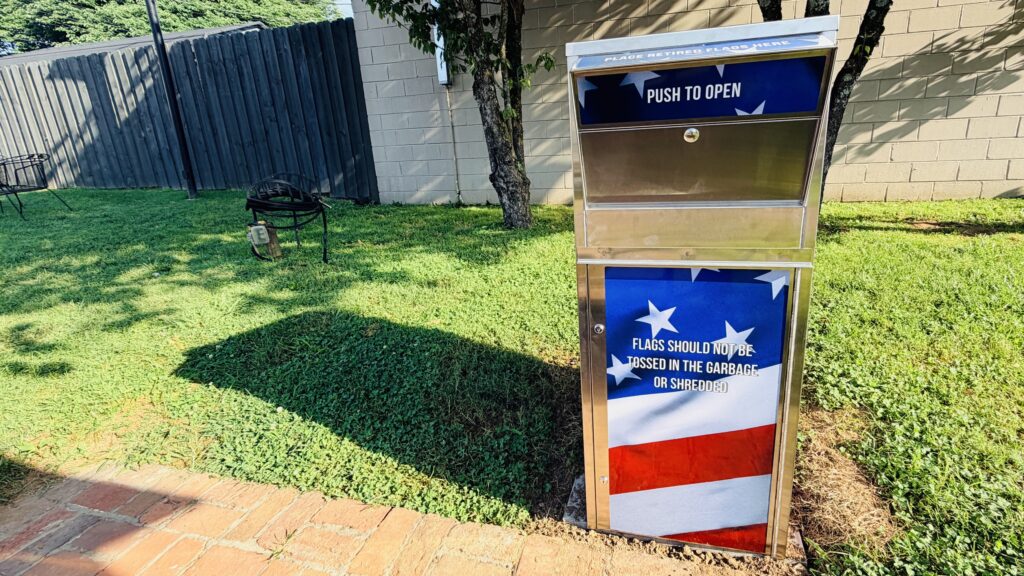
The Jack Daniel Distillery recently installed a flag retirement box on the Lynchburg Square near the gazebo, giving Moore County residents a convenient, respectful place to surrender worn or tattered flags for proper retirement. With the Fourth of July approaching, it’s a good moment to understand what flag retirement is, why it matters, and what the law actually says about it.
Jack Daniel’s Vice President and General Manager Melvin Keebler served in the U.S. Navy on nuclear submarines during his eight years of active duty. He says the distillery funded the community project because the distillery has always enjoyed a special relationship with veterans and the U.S. military. As an iconic American brand, the two go hand-in-hand.
“With the 250th birthday of America coming up, the flag retirement box just seemed like a great opportunity to show our respect and give Lynchburg folks an easy way to retire flags with dignity,” Keebler said.
GOVERNED BY TITLE 4 OF THE US CODE
The answer is in Title 4 of the United States Code, the law that governs the American flag. Section 8(k) is the relevant passage: “The flag, when it is in such condition that it is no longer a fitting emblem of display, should be destroyed in a dignified way, preferably by burning.”
That language — “preferably by burning” — has been in place since 1923, when most flags were made of cotton or wool and burning was a natural and complete form of dignified disposal. The Flag Code does not prescribe a specific ceremony, does not designate any particular organization as the authority over flag retirement, and does not prohibit alternative methods when burning is not practical. What it insists on is dignity.
One practical note worth knowing: most American flags today are made of nylon or polyester rather than natural fibers. Burning synthetic flags produces hazardous gases, including formaldehyde, ammonia, and carbon monoxide. For that reason, organizations that conduct formal retirement ceremonies often use a combination of natural-fiber and synthetic flags, rotating them carefully, or opt for ceremonial cutting and burial when burning isn’t appropriate. The retirement box on the Square collects flags and ensures they are retired properly, handling the logistics on behalf of residents who may not know how to proceed.
A flag flown outdoors around the clock has a life expectancy of roughly 90 days. One flown only during daylight hours and brought in during bad weather will last considerably longer. The first sign of wear is usually the fly end — the outer edge, farthest from the pole — which takes the most stress from wind. Fraying along the fly end, fading that obscures the colors, tears that cannot be repaired, or soiling that cannot be cleaned are all indicators that a flag has served its purpose and is ready to be retired with honor.
A flag that is simply faded or frayed at the edge is not necessarily beyond repair. Flags can be washed in cold water with mild soap, repaired along the fly end, and returned to service. Retirement is for flags that are genuinely no longer fit to fly — not for flags that just need a little care.
Flag retirement is not a bureaucratic formality. It is an expression of the same respect that governs how the flag is displayed, flown, folded, and handled throughout its service. The same code that says a worn flag should be burned also says the flag should never touch the ground, should never be used as clothing or decoration, and should be raised briskly and lowered ceremoniously. The retirement is the final act in a continuous practice of honor.
John Hart is a U.S. Army vet who served in Central America and Middle East. He also works in the Jack Daniel Distillery maintenance department and serves on the Jack Daniel Fire Brigade as an assistant fire chief. He says that the flag stands for the great American experiment. He also says he’s enjoyed the response from people from around the world visiting the U.S for FIFA World Cup. He sees their reaction to the U.S. as proof that it’s an amazing place.
“I think you’ve been able to see with all these soccer matches, how special America truly is,” he says.
When we ask him why it’s important to retire U.S. flags properly, he says it’s important because of what the flag represents.
“The stripes represent the 13 colonies and the stars represent the 50 states. Normally, when you retire a flag, you cut the 50 stars out, put them in a box and bury them. Then you take the stripes, and that’s the portion you burn.
The American Legion formalized the first flag retirement ceremony in 1937, and the tradition has been carried forward by veterans organizations, scout troops, civic groups, and schools ever since. A formal ceremony typically includes the folding of the flag, a moment of silence, the Pledge of Allegiance, and — where conditions allow — the playing of Taps. It is a solemn occasion, not a sorrowful one. The flag is not being discarded. It is being honored for its service, the same way the country honors the men and women who served under it.
WHAT TO DO WITH YOUR FLAG
If you have a flag that is no longer fit for display, the retirement box on the Lynchburg Square is now the simplest option for Moore County residents. Drop it off, and Jack Daniel’s will see to the rest.
For those who want to conduct their own retirement at home — particularly for a flag with personal history, one that flew over a specific place or through a significant moment — the Flag Code allows it. Build a safe fire in a fire pit or burn barrel, fold the flag respectfully into its traditional triangular shape, place it on the fire, and remain with it until it has burned completely. Ashes can be buried. The ceremony is yours to shape, guided by whatever words or readings feel right. What matters is that it is solemn, intentional, and complete.
This Fourth of July, if you find yourself looking at a flag that has flown its last season — one that came down faded and frayed from the porch, or the flagpole out front — you now know what to do with it. The Square is right there. The box is ready, and it’s absolutely free. •
About the Lynchburg Times: The Lynchburg Times is Moore County’s locally owned, independent news source and the only Lynchburg media source own by a Lynchburg native. We are also one of the few women-owned media organizations in the state. Our reporting is supported by readers, small business partners, and underwriters who believe community journalism matters. If this story was valuable to you, consider becoming a supporter at lynchburgtimes.com.