
By Tabitha Evans Moore
Editor & Publisher
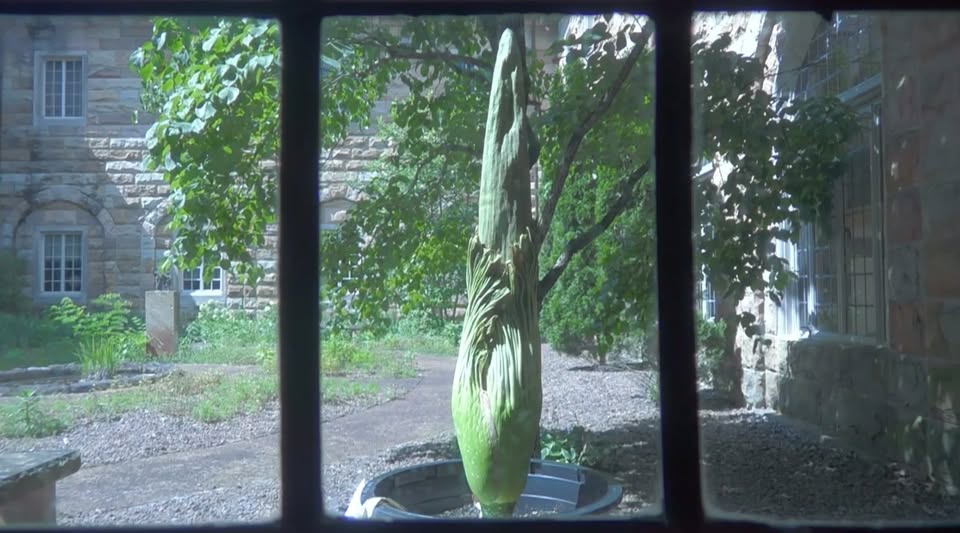
SEWANNEE, Tenn. — It’s 10 feet high, smells horrible, and blooms every 2-3 years. Those stats belong to the corpse flower (Amorphophallus titanum) — the largest unbranched inflorescence in the plant kingdom — and this July 4 one such flower named Independence is set to bloom again at the nearby Sewanee Herbarium located at the University of the South, and you can watch it from wherever you are.
According to folks at the herbarium, all signs point to a Fourth of July weekend opening for the towering plant. The bloom is currently expected around July 3 or 4 — though, as anyone who has watched a corpse flower before knows, nature keeps its own schedule. This will be Independence’s third showing on the Mountain. It last bloomed in 2023, and one of its earlier blooms also happened to fall on the Fourth of July, which is how the plant earned its name.
The plant has been moved from the Webb Greenhouse to the courtyard of Woods Labs, making it easier for visitors to see in person as it nears its dramatic opening.
STRANGEST SPECTACLE IN THE PLANT WORLD
The titan arum, as it’s also known, is native to the rainforests of Sumatra, Indonesia, and is one of the strangest spectacles in the plant world. What looks like a single giant flower is actually a cluster of many tiny male and female flowers, packed at the base of a tall central spike called a spadix, wrapped in a frilled, petal-like sheath called a spathe. The spadix alone can reach 6 to 12 feet tall.
The smell is the plant’s whole strategy. As the spathe opens, the spadix heats up to nearly human body temperature — close to 99 degrees Fahrenheit — and releases a powerful stench of rotting flesh. The combination of heat and odor mimics a decomposing carcass closely enough to fool carrion beetles and flesh flies, the plant’s natural pollinators, which are drawn in expecting a meal or a place to lay eggs. Instead, they leave covered in pollen, carrying it to the next titan arum that happens to be blooming nearby. The deep burgundy color inside the spathe completes the illusion, reinforcing the appearance of meat.
The smell is strongest during the first 12 to 24 hours of bloom, typically peaking after dark when its natural pollinators are most active, then fading by morning. The full bloom usually lasts three to four days before the spathe begins to collapse.
BLOOM WILL BE LIVE STREAMED
Titan arums require five to ten years of vegetative growth before they bloom for the first time, and even mature plants typically flower only once every several years. When a bud does finally form, it grows fast — four to six inches a day in the early stages — building toward an opening that unfolds over roughly a day and a half. Because the event is so rare and so short-lived, botanical gardens and herbariums around the world treat each bloom as a small occasion, often live-streaming the process the way the Sewanee Herbarium is doing with Independence.
The titan arum is also a conservation story. It is listed as endangered, with an estimated population of fewer than 1,000 individuals remaining in the wild, driven by logging and the conversion of its native Sumatran forest habitat to oil palm plantations. Specimens like Independence, cultivated and documented at institutions such as Sewanee, play a small role in preserving the species outside its shrinking natural range.
HOW TO SEE IT
For those who can’t make it to the Mountain in person, the Sewanee Herbarium is live-streaming Independence’s bloom online, with the feed available around the clock as the plant nears its opening.
For those who want the in-person experience — smell included — summer interns with the Sewanee Herbarium will lead tours Wednesday, Thursday, and Friday at 1, 2, and 3 p.m. Tours begin in the atrium of Spencer Hall, with the plant itself now situated in the Woods Labs courtyard for easier viewing. Whether you watch from the courtyard or from a phone screen back in Moore County, the timing is hard to beat: a flower named for Independence, doing the most dramatic thing it does roughly once every few years, right around the holiday that gave it its name.
To view the live stream, click here. •
About the Lynchburg Times: The Lynchburg Times is Moore County’s locally owned, independent news source and the only Lynchburg media source own by a Lynchburg native. We are also one of the few women-owned media organizations in the state. Our reporting is supported by readers, small business partners, and underwriters who believe community journalism matters. If this story was valuable to you, consider becoming a supporter at lynchburgtimes.com.
Leave a Reply
You must be logged in to post a comment.